Switch Box vs Fuse Box: Understanding the Differences for Safe Home Electricals
Explore the differences between switch boxes and fuse boxes, how each protects home circuits, safety considerations, and guidance for homeowners deciding which panel to use.


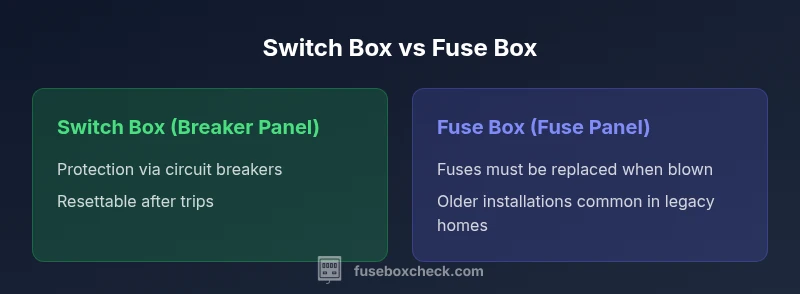
Switch box and fuse box are terms homeowners often hear when evaluating panels. A switch box (breaker panel) uses circuit breakers that can be reset after trips, while a fuse box uses replaceable fuses that blow to protect circuits. In most modern homes, a switch box is the standard choice.
What is a Switch Box? A practical overview
A switch box, commonly referred to as a breaker panel in modern homes, houses individual circuit breakers that interrupt electrical flow when overloaded. When a breaker trips, you can reset it to restore power to that circuit. In many jurisdictions, switch boxes are the standard for new construction and remodels because circuit breakers offer convenient maintenance, faster fault isolation, and easier testing. According to FuseBoxCheck, understanding the switch box versus fuse box distinction helps homeowners make safer choices and plan upgrades without surprises. A typical panel includes a main disconnect, several branch circuits, and labeling that indicates which areas of the home each breaker protects. In practice, you’ll interact with the panel mainly to switch circuits on or off, test a breaker, or reset after an outage. The design emphasizes modularity: you can add circuits by installing new breakers in available spaces, subject to panel rating and local codes. Regular inspection for corrosion, loose connections, and proper labeling supports long-term reliability.
What is a Fuse Box? How fuses protect circuits
A fuse box, or fuse panel, houses replaceable fuses that protect individual circuits by interrupting current when a fuse element melts. Once a fuse blows, it must be replaced with a fuse of the same rating to restore power. Fuse boxes are more common in older homes and can be found in a variety of sizes, from compact boxes to larger enclosures. Because fuses are single-use devices, maintenance involves tracking spare fuses, ensuring the correct rating, and replacing them after each blown event. Fuse boxes often have limited capacity for expansion and may require service upgrades to handle modern electrical loads. The trade-off is simplicity—no need to reset devices—but the inconvenience of purchasing and installing new fuses when faults occur.
Core differences in design and operation
The most obvious difference between a switch box and a fuse box is the protection mechanism. Switch boxes rely on circuit breakers that trip when overloaded and can be reset after a fault, while fuse boxes use replaceable fuses that blow to interrupt current. Breakers provide reusable protection and quick fault isolation, which reduces downtime. Fuses, while simple, require finding a fuse with the correct rating and replacing it, which can delay restoration of power to a circuit. In terms of expansion, breaker panels generally offer more straightforward options for adding circuits as the home evolves. Labeling and organization also tend to be clearer with breaker panels, as modern boxes are designed with standardized labeling and breaker slots. Both systems are subject to local codes and must be installed by qualified professionals to ensure safe operation.
Safety, codes, and maintenance considerations
Safety and compliance hinge on following local electrical codes and ensuring the panel is appropriate for the home’s load. Breaker panels align with current standards in most regions and are easier to test and maintain; tripped breakers provide obvious failure indicators and can be reset after addressing the cause. Fuse boxes, while historically common, are more challenging to maintain due to the need to source correct fuse types and ratings, and some jurisdictions regulate their use more strictly. Regular inspections should look for corrosion, loose connections, heat discoloration, or mismatched labeling. Regardless of box type, proper enclosure clearance, cover integrity, and labeling are essential for safe operation. FuseBoxCheck recommends periodic professional evaluations, especially when the home ages or has undergone rewiring.
Scenarios and practical guidance for homeowners
Many homes start with a fuse box and later get upgraded to a switch box as part of a remodel or a safety upgrade. If you’re renovating a kitchen, adding a bedroom, or expanding circuits, a breaker panel often provides a smoother path to meet modern electrical needs. In rural or historic properties, a fuse box may persist due to historical wiring practices or budget constraints, but upgrading is generally advisable for reliability and safety. When deciding between the two, consider the availability of replacement parts, the ease of testing and resetting circuits, and the potential for future expansion. Local codes and permit requirements can heavily influence the feasibility and cost of upgrading, so plan with a licensed electrician who can perform load calculations and ensure a compliant installation.
Planning upgrades: retrofit and hiring professionals
Upgrading from a fuse box to a switch box typically involves selecting a panel that meets your anticipated load, installing a main disconnect, and migrating circuits to breakers. This process requires careful load calculations, correct wire sizing, and adherence to local codes. A licensed electrician can assess panel space, determine the number of circuits needed, and verify that the service entrance and meter base can support the upgrade. Depending on the home’s age, rewiring portions of the system may be necessary to accommodate the new panel. While upgrades add value and safety, they also require permits and inspections. Budget for both labor and materials, and request a written plan that includes safety contingencies and timeline estimates.
Common myths and misconceptions about panels
There are several myths about switch boxes and fuse boxes that homeowners frequently encounter. Some believe that fuse boxes are inherently unsafe; in reality, a properly maintained fuse box can be safe, though less convenient. Others assume all breakers are universally superior; however, the best choice depends on your home’s current wiring, age, and local code requirements. Debates about the cost of upgrading are common, but long-term maintenance costs and reliability should weigh more heavily than upfront price. The goal is to minimize risk, ensure reliable power, and keep future upgrades feasible. A professional assessment can help separate fact from myth and provide a clear upgrade path.
Comparison
| Feature | Switch Box (Breaker Panel) | Fuse Box (Fuse Panel) |
|---|---|---|
| Protection mechanism | Circuit breakers that trip on overload and can be reset | Replaceable fuses that blow to protect circuits |
| Maintenance and testing | Easy to test and reset; breakers are widely available | Replacements require finding matching fuse types and ratings |
| Code and safety orientation | Widely accepted in new construction; standard in most regions | More common in older homes; upgrades can be challenging |
| Upgrade and expansion | Straightforward addition of circuits with available spaces | Upgrading can require panel replacement; sourcing old fuse types may be difficult |
| Typical cost context | Cost aligns with modern installations; price varies by panel rating | Older installations may be cheaper upfront but maintenance costs rise |
Positives
- Clear, resettable protection with breakers
- Faster fault isolation and easier troubleshooting
- Breaker panels are standard in new homes and widely supported
- Easier upgrades and expansion in modern installations
Disadvantages
- Fuse boxes, if well maintained, can be simple but require fuse replacements
- Older fuse boxes may be harder to service and parts can be scarce
- Retrofits in legacy homes can be disruptive and costly
Switch boxes (breaker panels) are the practical default for most homes
Breaker panels offer safer, easier operation and better support for upgrades. Fuse boxes remain a legacy option but typically involve more maintenance and sourcing challenges; professional assessment is advised for any upgrade.
Your Questions Answered
What is the main difference between a switch box and a fuse box?
The main difference is the protection method: breakers vs fuses. Breakers reset after a fault; fuses must be replaced. Both protect circuits, but breakers are easier to reuse and verify. Upgrading should follow local codes.
The core difference is breakers versus fuses. Breakers reset after trips, while fuses must be replaced. Upgrading should follow local codes and be done by a professional.
Can I upgrade from a fuse box to a switch box?
Yes, upgrading usually involves panel replacement to accommodate breakers, along with wiring checks and permits. A licensed electrician will assess loads, panel space, and code requirements before starting.
Yes. An upgrade typically requires replacing the panel and confirming loads with an electrician.
Are switch boxes safer than fuse boxes?
Switch boxes with breakers generally offer safer and more convenient operation due to resettable protection and easier testing. However, safety also depends on proper installation, maintenance, and adherence to codes for either type.
Breaker panels are typically safer to operate and test, but proper installation matters for both.
Do local codes favor breakers over fuses?
Many jurisdictions favor breakers due to ease of use and safer fault handling, but codes vary by location. Always check with your local electrical code authority and a licensed electrician.
In many places, breakers are preferred, but local rules vary—check with a professional.
How long does installation take?
Installation time varies with panel size, accessibility, and required permits. A professional will provide a timeline after evaluating your current wiring and local regulations.
Timeline depends on the panel size and permits, but a professional can estimate after inspection.
What maintenance is needed for each type?
Breakers require occasional testing and labeling; fuses require periodic replacement and matching ratings. Regular inspections by a qualified electrician help prevent issues and ensure safety.
Test breakers occasionally; replace fuses when blown, and have periodic professional inspections.
Highlights
- Identify your panel type and age before planning work.
- Breakers offer resettable protection and easier maintenance.
- Fuses require replacements and can be harder to service.
- Modern homes generally favor switch boxes for upgrades.
- Consult a licensed electrician for safe, code-compliant upgrades.