Fuse Box vs Sub Panel: Which Is Right for Your Home?
A comprehensive comparison of fuse boxes and sub panels. Learn the differences, costs, safety considerations, and installation tips to choose the best option for your home.


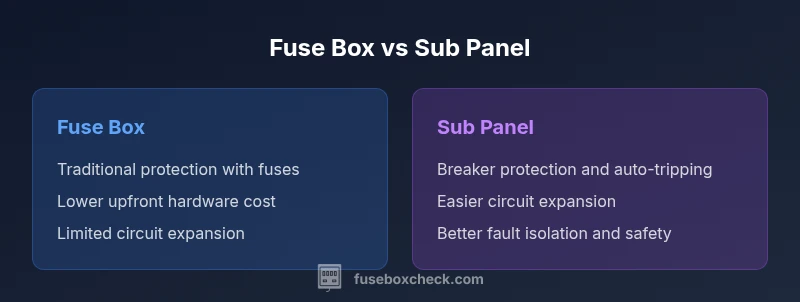
Fuse box vs sub panel: both distribute electricity, but a fuse box uses replaceable fuses while a sub panel uses circuit breakers for safer, more scalable power protection. In modern homes, a sub panel is typically recommended for expansion and safer fault isolation. For most homeowners, upgrading to a sub panel offers better long‑term reliability and easier future wiring compared to maintaining a traditional fuse box.
Understanding the basics: fuse box vs sub panel
In any home electrical system, the terms fuse box and sub panel describe two different but related components. The phrase fuse box vs sub panel is commonly used when homeowners plan upgrades, repairs, or new installations. A fuse box is the traditional distribution point that uses fuses to interrupt current, while a sub panel is a downstream distribution panel fed from the main service and protected by circuit breakers. According to FuseBoxCheck, understanding the distinction between these two options is essential for safe planning. The difference matters not just for today’s load but for future expansions, renovations, and long-term reliability. In most residential settings, the main panel (whether it houses fuses or breakers) serves as the control center for power. A sub panel provides a dedicated, scalable hub for additional circuits in a basement, garage, or detached building. For homeowners evaluating a retrofit or new construction, clarifying when to use a fuse box vs sub panel helps prevent costly rewiring and reduces safety risks.
How a fuse box works and its limitations
A fuse box relies on fuses that melt when current exceeds rating, interrupting power to a circuit. Traditional fuse boxes were common in mid‑century homes and are still found in older houses or in very small، simple installations. The main limitations include a fixed number of circuits, the need to replace fuses after each fault, and higher risk of overheating if the wrong fuse is installed. Because fuses do not trip automatically like breakers, a miscalculated load or a failed fuse can lead to nuisance outages or, in worst cases, overheating. Safety standards have evolved, and modern homes typically move away from fuse boxes in favor of more reliable protection.
What a sub panel does and when it’s appropriate
A sub panel is a downstream distribution center fed from the main service panel. It uses circuit breakers, which trip automatically when a fault is detected, reducing the risk of overheating and fire. Sub panels are ideal when an existing panel runs out of space, when you plan to add high‑demand circuits (like EV charging, air conditioning, or a workshop), or when you want to isolate different parts of the home for safety and convenience. Proper feeder sizing, grounding, and bonding are crucial, and a licensed electrician should perform the upgrade to ensure compliance with local codes and the NEC.
Safety and code considerations you should know
Electrical safety and code compliance are central to choosing between fuse box vs sub panel upgrades. The NEC requires appropriately sized feeders, correct grounding, and protection by overcurrent devices. GFCI and AFCI protection may be required in living areas and bedrooms, depending on the jurisdiction. Permits are often required for panel upgrades, and inspections verify that wiring methods, clearances, and enclosures meet current standards. Always plan for adequate space, ventilation, and accessibility; cramped or poorly ventilated panels can create hazards and complicate future maintenance.
Cost and installation considerations
Costs for fuse box vs sub panel work vary widely by region, feeder length, and existing wiring. A basic upgrade to a small sub panel might be less expensive than a full fuse box replacement, but upgrades that require running new feeders, upgrading service capacity, or relocating the panel can increase costs significantly. In many markets, you’ll see ranges that reflect labor, permit fees, and parts. For homeowners, it’s important to obtain multiple quotes and to factor in long‑term reliability and safety when evaluating upfront hardware costs. FuseBoxCheck analysis shows that homeowners who opt for a sub panel often recognize longer‑term value due to easier expansion and safer fault isolation.
Practical installation scenarios: retrofit and new builds
In retrofits, a sub panel is commonly installed to accommodate added circuits or to relieve load on an aging main panel. In new builds, planning a sub panel can simplify future expansions such as a new workshop or garage, EV charger, or a home theater system. The choice between fuse box vs sub panel in new construction is influenced by load calculations, local codes, and the desired service rating. Mid‑career renovations often involve additional considerations like location relative to appliances, accessibility for future upgrades, and whether the existing service can handle added demand without upgrading the main service
Maintenance tips and signs of issues
Regular inspection is essential for both systems. Signs you may be leaning toward a panel upgrade include frequent tripping of breakers (or blown fuses), warmth or buzzing near the panel, corrosion, or dimming when loads spike. With a fuse box, keep spare fuses on hand and replace only with the exact rated type. For sub panels, plan regular visual checks and have a licensed electrician perform the annual safety check. Proper labeling, clearances, and a clean, dry enclosure are simple steps that reduce risk and prolong service life.
Common myths vs reality
Myth: A fuse box is inherently unsafe and illegal in new homes. Reality: Modern codes generally require safe, appropriately sized protection, which can be implemented with fuses or breakers depending on the installation. Myth: Sub panels are always more expensive. Reality: While initial costs may be higher, long‑term maintenance, expansion flexibility, and safer fault isolation often make sub panels the better value for growing homes. Myth: Maintenance is optional. Reality: Regular inspection and testing are essential to prevent nuisance outages and safety hazards, regardless of which system you use.
Quick decision guide: choosing the right option for your home
If your home is small, uses few circuits, and has a historically simple electrical setup, a fuse box might be acceptable with careful maintenance. For most modern homes, especially those undergoing renovations or planning future upgrades, a sub panel offers greater flexibility, safety, and compliance with current codes. Always consult a licensed electrician to perform load calculations, confirm service capacity, and determine the optimal path for your specific situation. The right choice balances safety, future proofing, and total cost of ownership.
Comparison
| Feature | fuse box | sub panel |
|---|---|---|
| Definition and role | Traditional protection using fuses | Downstream panel fed from main service using breakers |
| Protection mechanism | Fuses (need replacement) | Circuit breakers (trip on fault) |
| Expansion capacity | Limited by fuse count/capacity | Easily adds circuits with new breakers |
| Upgrade path | Replace/upgrade fuse box components | Upgrade panel and feeder wiring |
| Cost range (installation) | Lower upfront hardware cost for small setups | Higher upfront cost for panel, feeders, and labor |
| Space and placement | Typically in existing enclosure or wall cavity | Must have room for feeder and proper clearance |
| Maintenance & safety | Fuses require inspection/replacement | Breakers provide auto-tripping and easier fault isolation |
| Best use case | Heritage or very small systems | Modern homes planning expansions, EVs, workshops |
Positives
- Potentially lower upfront hardware costs for small, simple loads
- Fuses are replaceable and parts are widely available
- Less invasive wiring changes in very small or heritage homes
Disadvantages
- Higher long-term maintenance and replacement costs
- Limited expansion capability in many older fuse boxes
- Greater risk of fire if fuses are installed improperly or fail
- Not ideal for modern homes with multiple high-demand circuits
Sub panel is the superior choice for most homes due to safety, expansion, and code readiness
In modern renovations and new builds, choose a sub panel to support more circuits and safer fault isolation. For small, heritage properties, a fuse box may suffice but will limit upgrades.
Your Questions Answered
What is the difference between a fuse box and a sub panel?
A fuse box uses fuses to interrupt power when overloaded, while a sub panel uses circuit breakers that trip automatically. A sub panel is fed from a main service and offers easier expansion and safer fault isolation. The choice affects future upgrades and safety.
A fuse box uses fuses; a sub panel uses breakers and is better for future upgrades.
Do I need a sub panel if I add new circuits?
Not always, but adding a sub panel often simplifies wiring and protects the main panel from overload. If you anticipate multiple new circuits or high‑demand loads, a sub panel is usually recommended.
If you’re adding several circuits, a sub panel is usually the better choice.
Can a fuse box be converted to a sub panel?
Yes, but it typically involves upgrading the feeder, replacing protectors, and ensuring grounding and bonding meet code. A licensed electrician should perform the conversion.
Conversions should be done by a licensed electrician to meet code.
What permits are typically required for panel upgrades?
Most jurisdictions require a permit for panel upgrades and electrical work. Inspections verify compliance with safety standards. Always check local regulations before starting.
Permits and inspections are usually required for panel upgrades.
How much does it cost to install a sub panel?
Costs vary by region and scope, often including labor, permit fees, and materials. Expect a broad range depending on feeder length, panel size, and any necessary service upgrades.
Costs depend on labor, wiring, and panel size; get multiple quotes.
Are fuse boxes legal in new construction?
Many regions require modern overcurrent protection, but some older or specialty applications may still use fuse boxes. Check current local codes and guidance from a licensed electrician.
Check local codes; many new builds prefer breakers for safety.
Highlights
- Assess current load before choosing a panel
- Plan for expansion needs to avoid future rewiring
- Choose sub panels for modern homes and future-proofing
- Ensure permits and inspections are part of any upgrade