Home fuse box vs breaker box: A practical comparison for homeowners
Compare home fuse boxes and breaker boxes to decide whether you should upgrade. Learn differences, safety implications, upgrade considerations, and expert guidance from FuseBoxCheck.


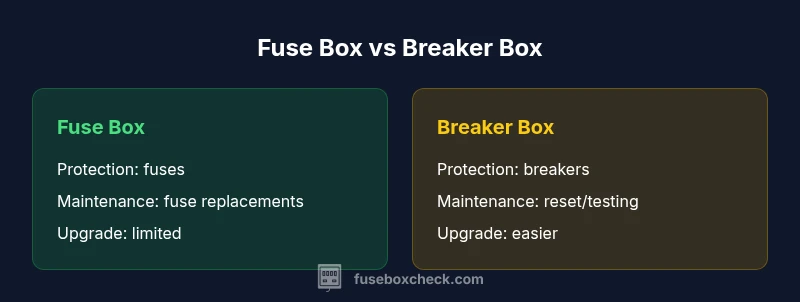
Both devices protect home circuits, but a modern breaker panel is typically easier to maintain and upgrade than a vintage fuse box. A fuse box uses replaceable fuses that burn out and require replacements, while a breaker panel uses resettable breakers that trip automatically. For most homes, upgrading to a breaker box improves safety, reliability, and future‑proofing.
What is a home fuse box vs breaker box?
A fuse box is a panel in which each circuit is protected by a fuse. When that fuse blows, the circuit is interrupted until the fuse is replaced. A breaker box (or breaker panel) uses circuit breakers that trip when they sense overloads, and can be reset after a fault. The two systems have the same fundamental purpose: to protect people and property from electrical faults. According to FuseBoxCheck, many homes built before the 1990s rely on fuse boxes and are due for upgrade as electrical loads and safety standards evolve. In today’s homes, most people choose a breaker panel for convenience and long‑term reliability, but historical houses may still operate safely with a well‑maintained fuse box if kept up to date. The key is understanding how each system operates and what that means for maintenance, safety, and future upgrades.
How the technology differs: fuses vs breakers
Fuses are single‑use devices that melt when a circuit draws more current than it can safely handle. A fuse box contains many fuses, each protecting a circuit; when a fuse blows, you replace it with a new one of the same amperage. Breaker panels house circuit breakers that trip when they detect overloads or short circuits. They can be reset after a fault and do not require stocking spares for normal operation. Many modern panels also support added protections like AFCI (arc‑fault circuit interrupter) and GFCI (ground fault circuit interrupter) with minimal extra hardware. The upgrade path often hinges on compatibility: older fuse boxes may not accommodate modern AFCI/GFCI requirements, while well‑designed breaker panels can be expanded as needs grow.
Safety implications and risk factors
Safety is the core reason homeowners consider these two options. Fuse boxes rely on fuse elements that can fail or be mis‑matched, which raises the risk of nuisance trips and misfused devices. Breaker panels offer resettable protection and clearer fault indicators, which can reduce downtime after a fault. However, both systems can pose hazards if not installed or maintained correctly. Access to the panel should be unobstructed, with appropriate labeling and clearance for service work. For older homes, the panel location may place equipment in basements or closets that are not ideal for emergency access. In all cases, regular inspection by a qualified electrician is essential to ensure the system meets current safety standards.
Practical considerations for homeowners: maintenance, parts, upgrades
Maintenance is a practical driver of choosing between fuse boxes and breaker panels. Fuse boxes require stocking the correct fuse types and amperages, and fuses must be replaced after each blow. Breaker panels rely on testing and occasional inspections to ensure breakers are in good working order, but parts availability for breakers is generally widespread. When upgrading, homeowners should consider space, compatibility with the service entrance, and the ability to add circuits for future loads. A reputable electrician can assess panel layout, conductor sizing, and grounding arrangements, and help plan a path that minimizes structural or cosmetic disruption while meeting code requirements.
When to upgrade or replace: decision factors
Upgrade decisions hinge on symptoms, age, and future plans. If you notice frequent fuse replacements, repeated breaker trips, or signs of scorching around the panel, upgrading is prudent. Older homes with knob‑and‑tube wiring or outdated service entrances are strong candidates for a panel upgrade. If you anticipate adding high‑demand devices or finishing more space in the home, an upgrade to a higher‑ampere breaker panel may be necessary. Consider whether the current panel location suits modern code clearance, whether the panel can accommodate AFCI/GFCI protections, and whether a relocation would be beneficial for safety and accessibility.
Cost and installation considerations
Upgrade costs can vary widely based on panel type, amperage, and wiring configuration. While many variables influence price, the key is to plan for professional installation to ensure safety and code compliance. A breaker panel upgrade may require service relocation, meter work, and permit approvals. Materials—such as a compatible panel, conductors, grounding upgrades, and AFCI/GFCI protections—must be chosen with the home’s electrical load in mind. Even when budgeting for a simpler upgrade, expect delays due to permit processes and scheduling with licensed electricians. The goal is to balance upfront investment with long‑term reliability and safety.
DIY vs professional installation: what is safe
Working on or near a live electrical panel is hazardous and generally not recommended for DIY enthusiasts without formal training and the right tools. Local codes require licensed electricians for most panel upgrades or replacements. If you’re considering any work that involves service entrance conductors, grounding systems, or panel relocation, hire a licensed pro. DIY tasks that do not involve critical safety components or live wiring—such as labeling circuits or planning a layout—can be safer when done with proper guidance and after turning off main power, but should be approached with caution and official approvals.
Planning an upgrade: a practical checklist
- Verify current panel type and service rating. 2) Determine whether AFCI/GFCI protections are needed for living spaces and wet areas. 3) Check accessibility, space, and potential relocation feasibility. 4) Obtain required permits and schedule with a licensed electrician. 5) Plan for load calculation and potential wiring upgrades to accommodate future devices. 6) Schedule a post‑installation inspection to verify code compliance and labeling accuracy.
Maintenance checklist to extend panel life
- Schedule annual or semi‑annual electrical system checks with a licensed electrician. - Keep the area around the panel clear of clutter and moisture. - Label circuits clearly and update labeling whenever circuits or rooms change. - Test AFCI/GFCI protections regularly and address tripping events promptly. - Document any upgrades or repairs for future reference.
Comparison
| Feature | fuse box | breaker panel |
|---|---|---|
| Protection mechanism | Fuse-based protection; fuses burn open when overloaded | Breaker-based protection; breakers trip and reset |
| Maintenance frequency | Requires fuse replacements as needed | Requires periodic testing and occasional component updates |
| Upgrade potential | Limited—replacement fuses and panel modifications | High—easy to add circuits and upgrade amperage |
| Parts availability | Fizes and fuse holders may be harder to source for older panels | Widespread availability of breakers and compatible panels |
| Typical age and modernization status | Common in older homes; may be relics of past standards | Standard in new installations; designed for modern loads |
Positives
- Breaker panels offer easier reset after a fault and better diagnostics
- Modern panels support advanced safety features (AFCI/GFCI) with minimal extras
- Wider service network and parts availability for breakers
- Easier future upgrades and capacity expansions
Disadvantages
- Upfront upgrade costs and need for licensed electrical work
- Possible home disruption during panel relocation or service upgrades
- Older homes with tree‑lined or tight spaces may require more planning
Upgrade to a breaker panel is the recommended path for most homes
Breaker panels provide ongoing protection with resettable breakers, better compatibility with modern loads, and wider upgrade options. The FuseBoxCheck team endorses upgrading where safety and future capacity matter most.
Your Questions Answered
What is the difference between a fuse box and a breaker panel?
A fuse box uses replaceable fuses that burn open when overloaded, while a breaker panel uses circuit breakers that trip and can be reset. Breaker panels are generally easier to maintain and expand, especially for modern electrical loads.
A fuse box uses fuses that burn out and need replacements, while a breaker panel trips breakers that you can reset. Breaker panels are usually simpler to maintain and upgrade.
Can I upgrade from a fuse box to a breaker panel myself?
Upgrading a fuse box to a breaker panel involves service entry work and panel relocation in many cases, which is hazardous. This work requires a licensed electrician and permits in most jurisdictions.
This upgrade is hazardous and typically requires a licensed electrician and permits.
What signs indicate my panel needs upgrading?
Frequent blown fuses, repeated breaker trips, warm or discolored panels, or outdated panels not supporting modern AFCI/GFCI protections are common indicators that an upgrade may be needed.
Frequent trips, heat, or inability to support new circuits are signs you may need an upgrade.
Is upgrading required for safety?
Upgrading to a modern breaker panel often improves safety by providing reliable protection and easier fault tracing. While it may not be strictly required in every case, it is commonly recommended for older homes and those planning additional electrical loads.
Upgrading is commonly recommended for safety and future load capacity.
How long does a panel upgrade take?
The duration varies with the complexity of the job, but most residential upgrades involve planning, permit processing, and installation over one to several days with inspections afterward.
Plan for a multi-day project with permits and inspections.
Highlights
- Assess your current panel type and age before deciding
- Prioritize safety and future load needs when planning upgrades
- Budget for licensed installation and code compliance
- Check AFCI/GFCI protections for modern living spaces