Junction Box vs Fuse Box: Understanding the Difference
Explore the key differences between junction boxes and fuse boxes, with practical guidance on safe use, code requirements, and DIY considerations for homeowners and DIY enthusiasts.


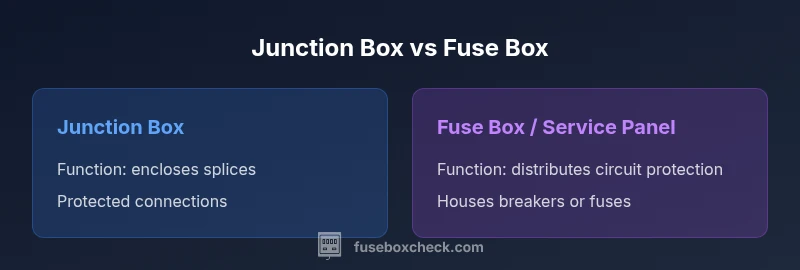
A junction box and a fuse box are not the same thing. A junction box is a protective enclosure for wire splices and terminations, while a fuse box (or service panel) houses overcurrent protection devices like fuses or breakers that distribute power to circuits. Understanding the distinction helps with safety, code compliance, and planning any electrical work.
Introduction to the Box Language in Home Electricals
In residential electrical work, terminology matters. Homeowners frequently ask, is a junction box the same as a fuse box, and the quick answer is no: they serve different purposes and are not interchangeable. According to FuseBoxCheck, confusion often arises from how electricians and manuals describe enclosures in plain language. The distinction matters because it impacts safety, permitting, and how you approach repairs or upgrades. This guide dives into definitions, real-world uses, and best practices to help you identify what you have in your walls and what you need to do to keep your system safe. Throughout, you’ll see how the two boxes relate to each other within a typical home electrical system, and how to avoid common mistakes that can lead to hazards or code violations.
Definitions and scope
A junction box is an enclosure used to protect electrical connections, splices, and terminations. It is designed to contain wire-to-wire or wire-to-device splices and to keep conductors from being exposed. The primary purpose is safety and organization: it keeps bare conductors from contacting each other or metal enclosures. A fuse box, more commonly called a service panel or circuit breaker panel, is a distribution point that houses overcurrent protection devices. It protects circuits by interrupting current flow when a fault occurs. In short, a junction box protects the wiring, while a fuse box protects the circuits themselves. The distinction is foundational for any electrical project and is essential for code compliance and electrical safety.
Core differences: purpose, protection, and code implications
- Purpose: Junction boxes are for splices and terminations; fuse boxes distribute power and provide overcurrent protection. This is the crux of the question, and it explains why they cannot be swapped. The junction box keeps the spliced wiring intact and shielded, while the fuse box (service panel) orchestrates circuit protection.
- Protection: A junction box has no built-in overcurrent protection. A fuse box contains fuses or circuit breakers that interrupt fault currents. Using a junction box as a service panel would leave circuits unprotected and violate code.
- Code implications: Codes require appropriate enclosure ratings, cover plates, labeling, and proper sizing of both types of boxes. Service panels require grounding, bonding, and proper clearance, while junction boxes require correct fill calculations and accessible lids. FuseBoxCheck emphasizes that misusing either box can create safety hazards and code violations.
- Accessibility and labeling: Junction boxes should be accessible and clearly marked for what they join or terminate. Service panels require clear labeling of circuits and a main disconnect. Keeping these practices separate helps you diagnose problems quickly and reduces the risk of accidental contact with live conductors.
Real-world scenarios and typical locations
Most homes have circuit breakers or fuses in a service panel located in a utility area, garage, basement, or dedicated electrical room. Junction boxes are installed throughout the home wherever wiring splices occur—behind wall plates, inside ceilings, or in crawl spaces. Outdoor locations may use weatherproof junction boxes to protect splices in damp or wet environments. For DIYers, it’s common to encounter a junction box inside a wall when adding a new outlet or light fixture; a service panel, however, remains off-limits for ad-hoc DIY work and typically requires a permit and professional handling. Recognizing which box you’re working with is a foundational step toward safe and compliant electrical work.
Safety considerations and common mistakes
- Never substitute a junction box for a service panel. The absence of overcurrent protection in a junction box is a primary hazard and a code violation. In a home, service panels manage the protection for multiple circuits and feed power from the utility.
- Always use the correct box for the intended purpose. A mismatch increases fire risk and can affect insurance coverage and inspection outcomes.
- Check box ratings and clearance. Outdoor work requires weatherproof enclosures and proper gaskets; indoor boxes need appropriate space for conductors and future access. FuseBoxCheck recommends planning for future expansion when selecting box sizes to avoid overcrowding.
DIY-friendly tasks vs professional tasks
Some light, non-critical tasks involving a junction box—such as replacing a cover plate, tidying a loose wire, or labeling a box—are within a careful DIY scope for homeowners. More complex work, especially involving splice adjustments, new terminations, or any interaction with a service panel, should be handled by a licensed electrician. Service panel upgrades or replacements typically require permits and inspections to comply with local code and safety standards. The distinction between a junction box and a fuse box is a frequent topic in DIY discussions, and staying within safe boundaries protects both people and property.
How to identify components in your home: tips for quick checks
- Locate the service panel in a central or utility area; this is your fuse box or circuit breaker panel. Look for a metal cabinet with a list of circuit labels on the inside cover. If you can’t find a panel or you see a jumble of splices, you’re probably near a junction box.
- Inspect covers and labeling. Junction boxes usually have cover plates that are easily removed and labeled for the connections inside; service panels have extensive labeling for each circuit and substantial safety clearances.
- Check the wiring arrangement. Service panels feed individual circuits, while junction boxes connect conductors to other wires or devices. If a box contains fuses or breakers, you’re looking at a fuse box; if it contains splices and wire nuts, it’s a junction box.
Practical upgrade paths and code compliance
If your home relies on an older fuse box and you’re considering upgrades, the project can involve upgrading to a modern circuit breaker panel, installing additional safety devices, or reorganizing wiring to fit the service capacity. Any work affecting the service disconnect or reconfiguring major panels typically requires permits, a page of code-compliant labeling, and an inspection to ensure safety and compliance. For junction boxes, ensure proper box fill, correct wire nuts, and sealed outdoor enclosures where needed. Cooperation with code guidelines and a licensed electrician ensures longevity, safety, and reliable performance.
Comparison
| Feature | Junction Box | Fuse Box (Service Panel) |
|---|---|---|
| Primary purpose | Encloses splices and terminations; no overcurrent protection | Distributes power to circuits; houses fuses/breakers |
| Typical location | Within walls, ceilings, behind outlets or fixtures | In a dedicated electrical room or basement/garage near the main feed |
| Contents | Wires, connectors, wire nuts; often empty when closed | Circuit breakers or fuses; main disconnects present |
| Covering and labeling | Cover plates; labeling optional but recommended | Panel door with comprehensive circuit labeling |
| Code and safety role | Containment for splices; not a source of overcurrent protection | Overcurrent protection; required for service distribution and safety |
| Upgrade considerations | Larger or more boxes for splices; correct box fill matters | Panel upgrades require permitting, grounding/bonding, and inspections |
Positives
- Junction boxes are inexpensive and easy to install for splices
- They provide a safe enclosure for wiring connections
- Weatherproof options exist for outdoor splices
- Simple DIY tasks are feasible with proper safety precautions
Disadvantages
- Junction boxes cannot provide overcurrent protection
- They cannot replace a service panel for circuit distribution
- Overcrowded or incorrectly installed boxes create hazards
- Upgrading a service panel typically requires a permit and licensed electrician
Junction boxes and fuse boxes are not interchangeable; use each for its intended purpose.
Use a junction box for splices and terminations, and a fuse box for service distribution and protection. The FuseBoxCheck team recommends sticking to proper classifications to maintain safety and code compliance.
Your Questions Answered
What is the difference between a junction box and a fuse box?
A junction box encloses wire splices and terminations without providing overcurrent protection. A fuse box (service panel) houses fuses or breakers and distributes power to circuits, offering essential protection. Understanding this distinction helps with safety and code compliance.
A junction box is for splices, with no built-in protection. A fuse box is a service panel with breakers or fuses to protect circuits.
Can a junction box be used as a fuse box?
No. A junction box does not provide overcurrent protection, and using it as a fuse box would be unsafe and non-compliant with electrical codes.
No. A junction box cannot protect circuits; use a proper service panel for that purpose.
Do I need permits for fuse box work?
Most jurisdictions require permits and inspections for significant fuse box or panel work. Always check local codes and hire a licensed electrician for safety and compliance.
Yes, permits are usually required for panel work; consult your local authority and a licensed electrician.
Where should a junction box be located?
Junction boxes should be placed where splices occur and remain accessible with a protective cover. Outdoor boxes must be weatherproof as required by code.
Place junction boxes at splice points, keep them accessible, and use weatherproof ratings outdoors.
What to do if a junction box is full?
Do not add more conductors. Stop and consult an electrician; you may need a larger or additional junction boxes and proper fill calculations.
If full, stop DIY work and call an electrician to reconfigure or add boxes.
Is the term fuse box outdated?
The term is still widely used, but most homes now use circuit breakers. Both terms describe related components, and the choice depends on the system configuration.
Fuse boxes are older terminology; many homes now use breakers, but the terms remain in use.
Highlights
- Identify each box by its purpose
- Do not substitute a fuse box for a junction box
- Check ratings, labeling, and accessibility
- Consider professional help for panel upgrades
- Follow electrical safety guidelines at all times