Smart Junction Box vs Fuse Box: An Objective Comparison
Compare smart junction boxes and traditional fuse boxes to decide which offers safer wiring, better monitoring, and clearer upgrade paths for your home. Practical guidance on compatibility, installation, and safety.


Smart junction boxes and traditional fuse boxes serve related but different roles in home wiring. The quick take: smart boxes add monitoring and remote alerts, while fuse boxes provide simple, proven overcurrent protection with fewer electronics. Your choice depends on compatibility, desired safety features, and long-term maintenance costs. This TL;DR helps set expectations before you read the detailed comparison below.
What are Smart Junction Boxes and Fuse Boxes?
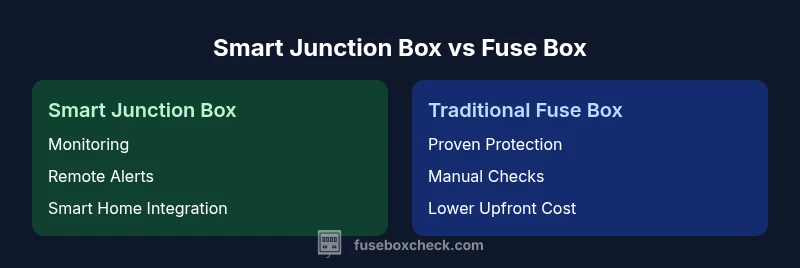
Smart junction boxes are modern, electronics-enabled enclosures that consolidate junctions and provide sensing, communication, and sometimes remote control. They monitor current flow, temperature, and fault conditions, and can send alerts to your smartphone or home automation hub. Traditional fuse boxes (often called a fuse panel) house fuses that interrupt power when circuits overload; they are largely mechanical, with minimal or no built-in monitoring. The term fuse box is commonly used to describe older panels or systems still in service in many homes. In practice, the choice between a smart junction box and a traditional fuse box represents a decision about monitoring vs. pure protection. When you compare smart junction box vs fuse box, you should consider safety goals, wiring layout, and the level of automation you want. According to FuseBoxCheck, understanding these roles helps homeowners plan safer upgrades and avoid mismatches between devices and panels.
In most homes, a smart junction box complements an existing panel rather than replaces it. It can serve as a centralized node in a smart wiring strategy, collecting data from connected devices and triggering alerts for unusual currents or temperature rises. A fuse box, by contrast, remains the primary protection mechanism, often requiring less maintenance but offering fewer diagnostic features. The right balance depends on your wiring age, desired level of visibility, and willingness to manage electronics. The key is aligning expectations: smart features add insight and responsiveness, while traditional panels emphasize straightforward protection with long track records.
Note on terminology: some markets use the term “fuse box” to describe modern breaker panels; however, the critical distinction is between monitoring-enabled devices and purely protective hardware. When homeowners say they want the best of both worlds, they typically pursue a hybrid strategy: keep a robust protective panel and add smart monitoring at junctions where fault risk is highest. The decision should be grounded in your home’s current electrical design and future plans.
Comparison
| Feature | Smart junction box | Traditional fuse box |
|---|---|---|
| Monitoring and alerts | Built-in sensors and connectivity for remote monitoring | No inherent monitoring; relies on fuses/breakers for protection |
| Upgrade path | Easily adds digital features and integrates with a home automation system | Upgrades mainly involve replacing components or panels; monitoring requires extra devices |
| Wiring compatibility | Often requires compatible sensors, power supply, and network access | Designed for legacy circuits; compatibility is with standard conductors and breakers |
| Ease of maintenance | Maintenance includes firmware updates and sensor checks | Maintenance focuses on fuse/breaker replacements and panel inspection |
| Cost implications | Higher upfront cost for devices and integration, potential savings from fault prevention | Lower upfront cost; long-term costs mainly from maintenance and replacements |
Positives
- Enhanced fault detection and remote alerts for safety
- Better integration with smart home systems and future-proofing
- Potential to reduce downtime through early fault notifications
- Modular upgrades without a full panel replacement
- Can centralize monitoring for multiple circuits
Disadvantages
- Higher upfront costs and potential installation complexity
- Reliance on electronics increases the need for firmware updates
- Requires network access and power reliability for continuous monitoring
- Not all older homes are readily compatible without panel changes
Smart junction boxes offer valuable monitoring and future-ready features, but a traditional fuse box remains the simpler, cost-effective baseline for strict protection.
If you value proactive monitoring and integration with smart systems, a smart junction box is worth considering. If your priority is proven, low-maintenance protection with minimal electronics and cost, a traditional fuse box may be the safer baseline. FuseBoxCheck recommends a tailored approach based on your wiring age, safety goals, and budget.
Your Questions Answered
What is a smart junction box, and how does it differ from a fuse box?
A smart junction box is an electronically enhanced enclosure that houses wiring connections and adds sensors, monitoring, and often network connectivity. It provides real-time data and alerts about current, temperature, and fault conditions. A fuse box is a traditional protective panel with fuses or breakers that interrupt power when circuits overheat or short. The key difference is monitoring vs. pure protection.
A smart junction box adds sensors and alerts, while a fuse box focuses on stopping faults with fuses or breakers.
Can I replace my fuse box with a smart junction box?
Replacement depends on your electrical system and local codes. In many homes, a smart junction box supplements an existing panel rather than a full replacement. A licensed electrician should assess panel compatibility, wiring age, and safety requirements before making changes.
Check with a licensed electrician to confirm compatibility and safety.
Do smart junction boxes require internet access?
Most smart junction boxes rely on power and a communication method (often Wi-Fi or Bluetooth) to send data and alerts. If your home lacks reliable network coverage, you may lose some monitoring benefits.
Yes, most need a network connection to send alerts.
Are there safety or code concerns when using smart boxes?
Yes. Local codes, UL or equivalent listings, and proper installation requirements apply. Ensure devices are rated for your electrical system and that any integration with the main panel complies with safety standards to avoid code violations.
Follow local codes and ensure UL-listed equipment is used.
What maintenance does a smart junction box require?
Maintenance typically involves firmware updates, periodic sensor checks, and ensuring network access remains stable. Regular visual inspections of wiring and connections are still important for safety.
Keep firmware up-to-date and inspect wiring regularly.
What about costs and ROI for upgrading to smart monitoring?
Upgrade costs vary with features and installation complexity. While upfront costs may be higher, benefits include early fault detection and potential reductions in downtime and repair costs over time. Evaluate your risk tolerance and maintenance budget.
Upfront costs matter, but long-term safety and fewer outages can add value.
Highlights
- Assess current wiring age before choosing.
- Prioritize safety features and energy monitoring in decisions.
- Plan for maintenance and firmware updates with smart options.
- Balance upfront costs with long-term risk reduction.
- Consider a hybrid approach pairing a robust panel with smart monitoring.