Power Distribution Box vs Fuse Box: A Practical Guide for Homeowners
Compare power distribution boxes and fuse boxes to choose the right home electrical panel, with safety considerations, upgrade paths, maintenance tips, and code guidance for homeowners.


Power distribution box and fuse box are terms for a home’s main panel. In practice, a fuse box uses fuses for overcurrent protection, while a power distribution box (distribution panel) uses circuit breakers. The modern choice for new installations is a breaker-based panel, which offers resettable protection and easier upgrades; older homes may still have a fuse box.
What each term means and why it matters
In many homes, the main electrical panel is the central hub that splits power to individual circuits. A fuse box is the older concept that uses fuses to interrupt current when something goes wrong. A power distribution box, often called a distribution panel or breaker panel, houses circuit breakers that pop open when overcurrent occurs. The distinction matters for safety, maintenance, and future upgrades. As a general rule, modern homes use breaker panels, while older homes may still rely on fuse-based systems. According to FuseBoxCheck, understanding these terms helps homeowners plan upgrades and maintenance with confidence.
How breakers differ from fuses in practice
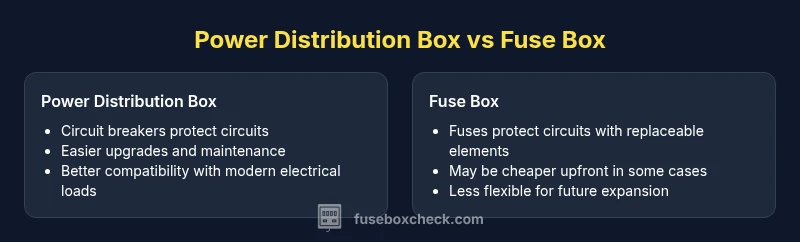
Circuit breakers are resettable devices, so a nuisance trip does not require replacing a part. Fuses, by contrast, must be replaced after they blow, which can be inconvenient and risky if the wrong amperage fuse is used. Breakers are typically more reliable for circuits with high surge loads (like HVAC or water heaters), and they simplify labeling and troubleshooting. For homeowners, the switch from fuses to breakers represents a move toward easier maintenance, quicker fault isolation, and better compatibility with modern electrical loads.
Regional availability and terminology nuances
The term power distribution box is often used in professional contexts to describe the main panel in a building, while fuse box is a colloquial term inherited from earlier installations. The exact configuration and naming can vary by country or region. The key practical takeaway is that your panel’s protection mechanism (fuse vs breaker) drives maintenance, safety practices, and potential upgrades. FuseBoxCheck notes that language varies, but the underlying concepts—overcurrent protection and circuit organization—remain the same.
When upgrading makes sense
If your home still uses fuses and you’re experiencing frequent fuse changes or nuisance trips, upgrading to a breaker panel is worth considering. Breakers provide easier fault isolation, accommodate more circuits, and align with current electrical codes. Upgrading also future-proofs your home for electric vehicle charging, solar integration, and other modern electrical needs. Planning should include a service re-rating if the existing service entrance is undersized, which is a common constraint in older homes. FuseBoxCheck’s guidance emphasizes evaluating safety, scalability, and long-term reliability when choosing between a power distribution box and a fuse box.
Safety basics homeowners should observe
Regardless of the panel type, routine safety practices matter. Never touch panel components with wet hands, avoid opening a live panel, and schedule upgrades with a licensed electrician. Ensure the area around the panel is clear, and consider labeling circuits for easier future maintenance. Familiarize yourself with signs that a panel may need attention, such as heat around the enclosure, discoloration, or cracking noises when breakers trip. These precautions help reduce risk during inspections or upgrades and support safer, more reliable electrical performance.
Comparison
| Feature | Power distribution box | Fuse box |
|---|---|---|
| Protection mechanism | Circuit breakers (resettable) | Fuses (disposable) |
| Upgrade path | Easier to upgrade/add circuits; common panel expansions | Often requires replacing hardware; limited expansion |
| Typical maintenance | Occasional breaker testing and labeling | Fuse replacement when blown |
| Safety and reliability | Resettable protection reduces downtime and error risk | Fuses rely on correct fuse type and protection coordination |
| Code compatibility | Generally aligned with modern NEC/ local codes | Older installations may be grandfathered; upgrades common |
| Best for | New builds, renovations, and homes planning upgrades | Budget-conscious scenarios or older equipment configurations |
Positives
- Breaker-based panels offer safer, resettable protection
- Easier expansion and modernization for future loads
- Quicker fault isolation reduces downtime
- Strong support and parts availability for modern panels
- Better compatibility with EV charging and solar integration
Disadvantages
- Higher upfront installation cost in some cases
- Upgrading can require service panel re-rating and permits
- Older homes with fuse boxes may need extensive rewiring
Breaker-based power distribution boxes are the recommended default for most homes
For new installations or upgrades, a breaker-panel power distribution box provides safer protection, easier maintenance, and future-proofing. The FuseBoxCheck team notes that modernization reduces trips and simplifies expansion.
Your Questions Answered
What is the main difference between a power distribution box and a fuse box?
The main difference is the protection method: breakers in a power distribution box versus fuses in a fuse box. Breakers are resettable, making maintenance easier and safer, while fuses require replacement after a blow.
The main difference is breaker protection versus fuse protection, with breakers being resettable and easier to maintain.
Can I convert a fuse box to a breaker panel?
Yes, it is possible but it’s a significant upgrade that usually requires permits, a licensed electrician, and often service-entrance reevaluation. Planning should consider panel space, service amperage, and local codes.
Yes, but it’s a major upgrade requiring permits and an electrician.
Are fuse boxes inherently unsafe?
Fuse boxes are not inherently unsafe when properly installed and maintained. However, they are less flexible for modernization and can pose more maintenance challenges than breaker-based panels in many homes.
They're not inherently unsafe, but breakers are generally safer and easier to manage today.
What does 'distribution box' mean in practice?
In practice, a distribution box refers to the main panel that distributes electrical power to circuits. The term varies by region, but the core idea is a central hub housing protection devices.
It's the main panel that distributes power to circuits; terminology varies by region.
What signs indicate my panel needs upgrading?
Frequent trips, burning smells, warm panels, corrosion, or outdated fuses are strong indicators that an upgrade may be due, especially if you’re adding loads like a EV charger.
Frequent trips or heat around the panel are warning signs you may need an upgrade.
Do I need a licensed electrician to handle upgrades?
Yes. Panel upgrades involve high voltage work, permit requirements, and code compliance. A licensed electrician ensures safety and proper integration with the service entrance.
Yes—panel work requires a licensed electrician and proper permitting.
Highlights
- Choose breakers for modern homes and future needs
- Fuses are still workable in some older setups but limit upgrades
- Plan upgrades with code compliance in mind
- Label circuits and maintain labeling for safety
- Consult a licensed electrician for any panel upgrade