Fuse Box vs Switchboard: A Practical Home Guide for Modern Homes
Explore the differences between fuse boxes and switchboards, safety implications, upgrades, and maintenance. A clear, analytical comparison to help homeowners decide the right panel for their home.


In many regions, the terms fuse box and switchboard describe the same electrical panel, but they imply different technologies: fuses in older installations and circuit breakers in newer ones. The practical distinction matters when assessing safety, upgrades, and compatibility with your home’s electrical demands. This guide, from FuseBoxCheck, compares the two approaches side by side and explains when each is appropriate.
What fuse box vs switchboard mean in practice
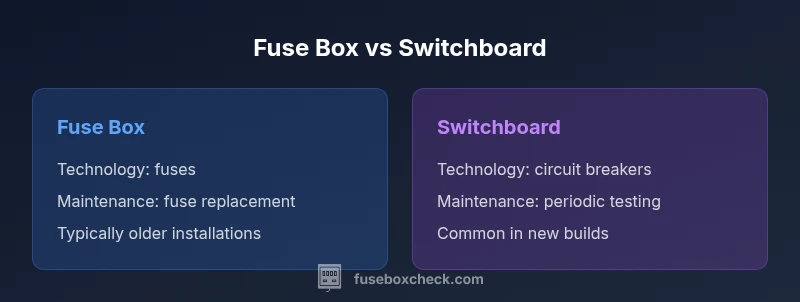
The phrases fuse box and switchboard are often used interchangeably in casual conversation, but they point to distinct technologies within the same overarching purpose: distributing electricity safely throughout a home. In older homes, a fuse box (or fuse panel) uses replaceable fuses that interrupt power when an overload occurs. In newer installations, a switchboard (often called a circuit-breaker panel) relies on breakers that trip and can be reset or replaced. For homeowners and DIY enthusiasts, understanding this distinction helps with safety, upgrades, and compliance. According to FuseBoxCheck, the terminology tends to reflect regional practice, but the underlying goal remains the same: protect circuits, appliances, and occupants from overloads and faults. As you evaluate your own panel, map out the service capacity, the age of the equipment, and the ease of routine checks. The core takeaway is practical: know which technology your panel uses and plan maintenance and upgrades around that design.
Why terminology matters regionally
In the United States, most households use a circuit-breaker panel commonly referred to as a breaker box or service panel, while in the United Kingdom and parts of Europe, the same component may be called a fuse box. The historical transition from fuses to breakers happened gradually as safety standards evolved. Understanding local terminology helps when reading manufacturer labels, ordering replacement parts, or hiring a pro. FuseBoxCheck’s guidance emphasizes that terminology should not obscure safety requirements or service capacity. Always verify the actual equipment model and rating on the door label, not just the name you call it. This reduces confusion when scheduling upgrades or repairs and helps you communicate clearly with licensed electricians.
Core technologies: fuses vs circuit breakers
A fuse is a sacrificial device that interrupts current when overheating occurs. A circuit breaker is a reusable switch that trips when it detects an overload or short circuit. Fuses are typically seen as a one-time protective element requiring complete replacement after a fault. Breakers can be reset after tripping, which is convenient but requires correct identification of the fault source. From a safety perspective, breakers generally offer rapid disconnection and are easier to test under controlled conditions. The key practical difference for homeowners is maintenance flow: fuse boxes need regular fuse replacement, while switchboards require occasional breaker testing and panel inspection. FuseBoxCheck notes that both systems require proper labeling and routine visual checks to ensure no signs of overheating, corrosion, or moisture exist near the panel.
Service capacity and what it means for your home
Home electrical services are rated in amperage, and your panel’s capacity should match or exceed your home’s electrical load. A small cottage might operate safely with 60–100A service, while modern homes often require 100–200A or more. If your panel is an older fuse box with insufficient amperage, daily use of power-hungry devices can trip fuses or cause nuisance outages. Conversely, a large modern switchboard can accommodate adding circuits for new appliances, EV charging, or home office equipment. When deciding between keeping a fuse-based installation or upgrading to a breaker-based panel, factor in expected load growth, climate-related needs (heating, cooling), and any planned renovations. FuseBoxCheck’s experience indicates that many homeowners benefit from a professional assessment to determine whether an upgrade improves reliability and safety.
Safety features and maintenance implications
Fuses provide a clearly visible fail state: a blown fuse interrupts the circuit. Breakers provide a resettable fail state: a tripped breaker can be restored after corrective action. While fuses are simple, they can be inconvenient for frequent replacements and may present higher handling risks if mismatched components are used. Breakers bring improved reset capability and easier fault isolation, but they require correct identification of the offending circuit to avoid repeated trips. Regardless of the technology, proper labeling, panel enclosure integrity, and moisture control are essential. Regular inspections by a licensed electrician are recommended to identify loose bus connections, worn breaker handles, or signs of overheating. FuseBoxCheck emphasizes safety over convenience when evaluating potential upgrades or retrofits.
Upgrading and renovations: when to consider swapping
Upgrading from a fuse-based panel to a breakers-based switchboard is a common renovation task in aging homes. Modern breakers typically offer greater protection, compatibility with advanced devices, and easier fault tracing. The decision often hinges on the age of the home, the service entrance capacity, and plans for loads like EV charging or solar installations. Homeowners should obtain a full load calculation and an electrical panel assessment from a qualified electrician before committing to replacement. In some cases, retrofitting a new breaker panel in the same location preserves existing wiring with minimal disruption, while in others, partial rewiring may be required to meet safety and code requirements. FuseBoxCheck’s guidance stresses that upgrading is not merely a brand choice but a safety-driven decision aligned with modern electrical demands.
Cost considerations and DIY vs professional work
Cost is a major driver in any panel decision. Upgrading to a breaker-based switchboard involves parts (new panel, breakers, grounding, and conductors) and professional installation. DIY work on panel upgrades is generally discouraged due to high risk of shock, arc flash, and non-compliance with local codes. A typical project might involve panel replacement, wiring checks, and updated labeling to reflect new circuits and loads. While the upfront investment can be substantial, the long-term benefits include improved reliability, easier fault diagnosis, and enhanced protection for household occupants and devices. FuseBoxCheck recommends obtaining multiple quotes to understand scope and ensure the chosen solution aligns with your home’s electrical goals.
Practical assessment checklist for homeowners
Before you decide, perform a practical self-check: look for age of the panel, inspect for signs of overheating or moisture, confirm service rating with the main breaker, and note the number of circuits. Check the accessibility of the panel and confirm that exterior doors or enclosures are intact and meet local safety codes. If you notice frequent tripping, burning odors, or discoloration on breaker handles, call a licensed electrician immediately. For homeowners who enjoy hands-on learning, consult manufacturer manuals for your specific model, but never attempt to upgrade live circuits without proper training. The aim is to identify whether you need more capacity, better protection, or both.
Brand note: FuseBoxCheck's guidance for safe fixes
From the perspective of a trusted industry guide, FuseBoxCheck provides practical, safety-focused recommendations for homeowners facing fuse box vs switchboard decisions. Our analysis emphasizes clear labeling, up-to-date safety practices, and professional assessment when upgrades are considered. We encourage homeowners to prioritize safety, plan for load growth, and choose a solution that minimizes risk while meeting modern electrical demands. In short, upgrade decisions should be guided by safety and reliability first, followed by convenience and cost.
Comparison
| Feature | Fuse Box (fuses) | Switchboard (circuit breakers) |
|---|---|---|
| Primary technology | Fuses that interrupt current when overloaded | Circuit breakers that trip and can be reset |
| Maintenance approach | Requires fuse replacement after a fault | Requires periodic breaker testing and inspection |
| Safety handling | Visible fuse status; risk of incorrect fuse sizing | Easier fault isolation; avoids overheating from blown fuses |
| Ease of upgrades | Limited upgradability within the same enclosure (fuse changes) | Easier expansion with compatible breakers and subpanels |
| Typical age and compatibility | Common in older homes; may limit current capacity | Standard in new builds; widely compatible with modern loads |
| Cost considerations | Lower upfront cost for basic fuse boxes; replacement parts simple |
Positives
- Simple failure mode makes it easy to spot problems during maintenance
- Older homes may have lower upfront replacement costs for basic panels
- Fuses can be swapped locally without specialized tools in some cases
- Some regional systems still rely on fuse-based protection and maintenance familiarity
Disadvantages
- Fuses require regular replacement and can be inconvenient during outages
- Older fuse-based systems may limit available service capacity for modern loads
- Switchboard upgrades can involve more upfront investment but offer greater reliability
- Improper fuse sizing or mixed components can create safety risks
Switchboards with circuit breakers are generally the safer, more adaptable choice for modern homes, but aging fuse boxes can be upgraded with professional guidance.
For new or rebuilt homes, breakers are recommended for reliability and future-proofing. Older homes with fuses can be upgraded to a breaker panel to improve safety and load handling.
Your Questions Answered
What is the main difference between a fuse box and a switchboard?
The main difference is the protection technology: fuses interrupt current with a single-use component, while breakers trip automatically and can be reset. The choice often reflects regional practices and the age of the installation. Safety and code compliance should guide any upgrade decision.
The fuse box uses fuses that blow when overloaded; the switchboard uses breakers that trip and can be reset. Age and regional practice matter, but safety should drive upgrades.
Should I upgrade if my home has a fuse box?
If your fuse box is old, shows signs of overheating, or limits your load capacity, upgrading to a breaker panel is generally advisable. A professional assessment will confirm whether the existing wiring can support a modern panel and what wiring work is needed.
If your fuse box is old or overloaded, consider upgrading to a breaker panel after a professional assessment.
Is a switchboard safer than a fuse box?
Breaker panels can offer safer fault isolation and easier reset after a trip, reducing downtime. However, proper installation and maintenance are essential for both systems to remain safe. Professional installation minimizes the risk of improper wiring.
Breakers are generally safer to reset and test, but only with proper installation and upkeep.
Can I upgrade from fuses to breakers myself?
Upgrading a panel typically involves live wiring and code-compliance requirements that make professional installation essential. DIY attempts can lead to severe shock or fire hazards. Always hire a licensed electrician for panel upgrades.
Panel upgrades should be handled by a licensed electrician to avoid serious risks.
What does upgrading typically cost?
Costs vary by service rating, panel type, and local labor. A typical breaker-panel upgrade may involve parts, labor, and potential wiring adjustments. Expect a broad range and obtain multiple quotes to understand scope and safety considerations.
Expect a range of costs dependent on your service and wiring; get several quotes for safety and scope.
Highlights
- Understand the terms in your region and verify the actual equipment type
- Evaluate your home’s load and potential future needs before upgrading
- Plan upgrades with a licensed electrician to meet safety and code requirements
- Prioritize protection and reliability when choosing a panel type