How to Update Your Fuse Box to a Circuit Breaker
Step-by-step guide to safely upgrading a fuse box to a circuit breaker panel, with essential safety checks, tools, and professional guidance on when to hire help.


You will learn how to update a fuse box to a circuit breaker by planning a safe upgrade, verifying compatibility, gathering the right tools, and following a structured step-by-step process. This guide also covers safety considerations, permits, and when to call a licensed electrician to ensure compliance with local codes.
Why Upgrade: Fuse Box Basics and Safety
Upgrading from a fuse box to a circuit breaker panel is one of the most consequential safety improvements you can make in a home electrical system. If your home still relies on fuses, you already deal with nuisance trips and slower fault isolation. The upgrade reduces fire risk and makes wiring faults easier to identify. According to FuseBoxCheck, homeowners who complete a properly planned upgrade experience improved reliability and easier future wiring upgrades. This change matters because it aligns with modern electrical loads and makes fault isolation clearer for maintenance and troubleshooting. If your home uses aluminum wiring, or the panel is older than 40 years, assess with a qualified electrician before proceeding. Safety comes first, and a well-planned upgrade minimizes risk for your family.
Key Differences: Fuses vs Circuit Breakers
Fuses and circuit breakers provide overcurrent protection, but they do so in different ways. A fuse is a consumable sacrificial link that must be replaced after each fault, whereas a breaker trips and can be reset. Breakers offer reusable, clearly labeled protection and faster fault isolation, which reduces downtime and potential damage to wiring. In addition to reliability, circuit breakers enable easier upgrades to meet increasing electrical demands, such as electric heating, modern HVAC, and high-wattage appliances. For homeowners, the practical impact is fewer trips, faster troubleshooting, and a safer panel. Remember that upgrading involves choosing a compatible panel and ensuring proper grounding and bonding per local codes. FuseBoxCheck notes that the right panel design can simplify future maintenance and panel labeling.
Assess Compatibility: Is Your Home Ready?
Compatibility is the first big hurdle in any fuse box upgrade. Start by checking the main service rating (in amperes), the number of spaces available in the new panel, and the condition of the service conductors. If the service drop is undersized for anticipated loads, or if your current panel lacks enough spaces for full circuit wiring, upgrading may require service entrance work by a licensed electrician. Look for signs of corrosion on the bus bars, loose bus connections, or hidden damage behind the panel cover. You’ll also need to consider grounding and bonding requirements, as well as the potential need for a new meter base or service upgrade. FuseBoxCheck recommends a professional assessment if the home is older, has aluminum wiring, or shows signs of wear.
Tools, Materials, and Safety Gear (Overview)
A successful upgrade requires careful planning and the right toolkit. This section covers the core tools and safety gear you’ll need, plus how to plan the layout of the new panel in your space. Expect to work with a wide range of components, including the new circuit breaker panel, bus bars, grounding hardware, and properly sized conductors. You will also need to verify that the existing wires can be terminated correctly in the new panel without overstressing any conductors. Before touching anything, ensure you understand the color code and conductor sizing limited by your local code and the NEC. Always maintain a clean workspace, label every wire during transfer, and keep a detailed circuit map for future reference. Consulting the NEC and local electrical codes is essential to ensure a compliant upgrade.
Common Pitfalls and How to Avoid Them
Rushing the upgrade is a common mistake that leads to miswiring, incorrect breaker sizing, or missing neutrals. Always confirm that the panel area is clean, dry, and well-lit. Never replace a main service disconnect without verifying the service entrance capacity and following lockout/tagout procedures. Mislabeling circuits can complicate future maintenance, so take time to map each circuit and check the correct breaker type for each circuit. If your panel is not clearly labeled or the existing wiring shows signs of heat damage, plan for a professional assessment. Avoid repurposing old knockouts or forcing wires into spaces they don’t fit, which can stress conductors and produce overheating. FuseBoxCheck emphasizes that cautious planning and correct equipment selection are the best guards against costly mistakes.
Aftercare and Testing: Verifying the Upgrade Works
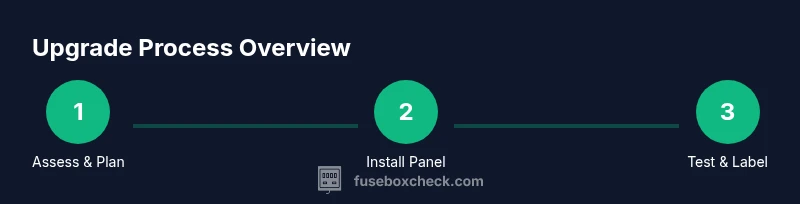
Once the upgrade is installed, thorough testing is essential. Start by performing a careful visual inspection of all connections, ensuring that neutrals are properly landed and grounds are bonded. Power up in a controlled test sequence, verifying each circuit trip on both overload and short-circuit conditions. Use a calibrated circuit tester to confirm voltage levels across each branch circuit and double-check that the main disconnect operates correctly. If any breaker trips unexpectedly, re-check wiring and confirm compatible breaker types and ratings. After testing, label all circuits clearly and generate a printed wiring diagram for future reference. Remember that final acceptance testing must align with local codes and safety standards. FuseBoxCheck underscores the value of documenting every step to support future inspections and renovations.
Authority Sources
For readers who want deeper code guidance or official standards, consult these sources:
- National Electrical Code (NEC) – nfpa.org
- U.S. Department of Energy safety guidelines – energy.gov
- California Electrical Code overview – czengineers.edu These sources provide foundational safety standards and code guidance that underpin any upgrade project and can help you determine whether a professional permit is required.
Tools & Materials
- Non-contact voltage tester( essential to verify power is fully off at each stage.)
- Insulated screwdrivers (Phillips and flathead)( for panel screws and bus connections.)
- Voltage tester with continuity check( to verify circuit integrity and grounding.)
- Lockout/tagout kit( to prevent accidental re-energizing during work.)
- Wire stripper/crimper( to prepare conductors for new connections.)
- Wire cutters( ensures clean conductor lengths.)
- New circuit breaker panel compatible with existing service( ensure space, rating, and rating compatibility.)
- Grounding electrode conductor and bonding clamps( per code for proper bonding.)
- Electrical tape and labeling supplies( for safe, durable wire marking.)
- Electrical gloves and eye protection( personal protective equipment for safety.)
Steps
Estimated time: 2-6 hours
- 1
Power down and verify
Shut off the main service disconnect and verify there is no voltage present with a non-contact tester before touching any panel components.
Tip: Always assume a live line until tested; this reduces the risk of arc flash. - 2
Remove the old fuse panel cover
Carefully remove screws and set the cover aside; document and label any visible wiring to help when transferring to the new panel.
Tip: Keep track of each wire and its original position to avoid miswiring later. - 3
Plan the new layout and identify breakers
Review the planned panel wiring map; determine which circuits go to which breakers and ensure the panel has enough spaces for future expansion.
Tip: Plan for a 20% spare capacity to accommodate future loads. - 4
Install the new panel and mount
Secure the new panel to the wall, ensuring it is level and accessible, then guide conductors into the appropriate bus bars and spaces.
Tip: Use proper mounting hardware and avoid over-tightening panel screws. - 5
Connect neutrals and grounds
Land neutrals on the neutral bar and bond grounds to the grounding system as required by code and the panel manufacturer.
Tip: Keep neutrals and grounds separate and clearly labeled. - 6
Install breakers and finish wiring
Install the main breaker and branch breakers in their designated positions; route conductors cleanly and restore panel labeling.
Tip: Ensure each breaker is the correct type and rating for its circuit.
Your Questions Answered
Is it legal to replace a fuse box with a circuit breaker in my area?
Regulations vary by location. In many places, upgrading requires permits and inspection. Check your local electrical code and consult a licensed electrician to ensure compliance.
Regulations vary by location; most areas require permits and an inspection for a fuse box upgrade.
Do I need a permit to upgrade my fuse box to a circuit breaker panel?
Most jurisdictions require a permit for major electrical work such as a panel upgrade. A permit ensures the work is inspected for safety and code compliance.
Yes, typically a permit is needed for a panel upgrade and inspection ensures compliance.
Can I perform the upgrade myself, or should I hire a pro?
If you have strong electrical knowledge and follow safety guidelines, you may attempt under strict code compliance. For most homeowners, hiring a licensed electrician is safer and often faster.
It’s possible for skilled DIYers, but many people hire a licensed electrician for safety and code compliance.
What are common signs that my fuse box needs upgrading?
Frequent fuse blows, dimming lights, panels that overheat, or an aging panel (over 40 years) suggest upgrading. Aluminum wiring or corrosion are additional warning signs.
Frequent trips, overheating, or an old panel usually means an upgrade is due.
How long does a typical upgrade take?
Typical timelines range from a few hours to a full day, depending on panel location, wiring complexity, and upgrades needed to the service entrance.
Usually a few hours to a day, depending on setup and local codes.
What is the approximate cost of upgrading a fuse box to a circuit breaker?
Costs vary widely by panel size, labor rates, and whether service upgrades are needed. Get multiple quotes from licensed electricians for a clear range.
Costs vary; talk to electricians for a precise estimate.
Watch Video
Highlights
- Upgrade improves safety and fault isolation
- Ensure compatibility and permits before work
- Label circuits thoroughly to simplify future maintenance
- Only proceed if you have the right tools and experience
- Consult local codes and consider professional help for service upgrades