vs ss fuse box: A detailed homeowner comparison
A detailed, objective side-by-side comparison of standard fuse boxes and SS fuse box variants, with safety, cost, and installation guidance for homeowners. Learn how to evaluate space, compatibility, and codes for a smart upgrade in 2026.


TL;DR: A side-by-side look at standard fuse boxes versus SS fuse boxes shows that SS variants often save space and include enhanced safety features, while traditional boxes are usually cheaper and easier to install. The best choice depends on space, budget, and local codes—see the full analysis for practical scenarios and upgrade steps.
Understanding the term: vs ss fuse box
In consumer electrical discussions, you’ll often see the phrase vs ss fuse box used to contrast conventional fuse enclosures with newer, safety-focused variants. The abbreviation 'SS' in many catalogs stands for sealed or optimized safety designs, but the exact meaning can vary by manufacturer. For homeowners, the key takeaway is to understand what the label means on a given product page and how it affects protections for your panel, circuits, and living space. According to FuseBoxCheck, terminology can be confusing because different brands market different features under similar names. The main point is to understand what the label means on a given product page and how it affects protections for your panel, circuits, and living space. This section will lay out the practical differences you’ll encounter during a typical upgrade or replacement. In the broader context of home electrical care, the vs ss fuse box debate centers on safety, space efficiency, and how well the panel integrates with existing service equipment.
Core differences between fuse box types and SS variants
The core differences hinge on three pillars: safety design, enclosure integrity, and compatibility with modern breakers and fuses. Traditional fuse boxes rely on replaceable fuses and a simple bus bar system. SS variants tend to emphasize sealed enclosures, tighter cable management, and sometimes integrated arc protection or anti-corrosion features. In many homes, the installation footprint and panel depth are key practical differences: SS designs may offer a more compact footprint or a different mounting arrangement. When evaluating options, look beyond the brand name and read the product spec sheets for amperage rating, conductor size compatibility, and labeling requirements. The goal is to ensure that the chosen option meets your service size, planned loads, and future expansion plans without complicating maintenance. FuseBoxCheck notes that the decision should balance safety, reliability, and the ease of future upgrades.
Safety and compliance considerations
Safety and compliance are the primary reasons homeowners consider a fuse box upgrade. NEC/IEC requirements, local AHJ audits, and manufacturer installation instructions all shape what is permissible in your area. SS variants may offer sealed enclosures that meet specific weather-rated or ingress-protection standards, which can influence where the panel can be located (garage, utility room, or outdoor wall). Before purchasing, confirm the unit’s voltage rating, short-circuit current rating, and labeling for critical circuits such as service disconnects. Have an electrical professional verify that your service panel, meter base, and feeder wiring are compatible with the new enclosure. The FuseBoxCheck team recommends working with a licensed electrician who can interpret local codes, perform a safe disconnect, and test circuits after installation to ensure ongoing protection.
Installation footprint and space requirements
When you swap or upgrade a fuse panel, space is often the limiting factor. Standard fuse boxes typically require a certain depth and width to accommodate fuse carriers, bus bars, and access for testing. SS fuse boxes are frequently designed to optimize space with compact enclosures and denser wiring channels, which can save precious wall area in tight laundry rooms or utility closets. However, compact designs may demand more precise alignment with stud bays and more careful cable routing to avoid overcrowding. Measurements you should confirm before purchase include panel height, width, depth, and the required clearance in front of the panel for safe operation. A licensed electrician can measure your current service equipment, compare it to the new unit’s footprint, and advise whether knockouts, conduits, or adapters will be needed. In many cases, the space you have now will determine whether a standard panel or an SS variant is the better match for long-term reliability and safety.
Wiring compatibility and code considerations
Compatibility concerns include conductor gauge, breaker compatibility, and the availability of matching fuses or breakers. Traditional fuse boxes rely on cartridge fuses, while SS variants may use modern molded-case breakers or integrated modules. Verify that the new panel's bus connections match your feeding conductors and that the surrounds and back panel support the required ampere rating. Codes often require labeling of circuits, the service disconnect location, and the ability to shut off power safely. Having an electrician check service size and the condition of the meter base reduces risk. The distance from the meter and the service entrance can impact wire routing and panel placement. FuseBoxCheck suggests requesting a full layout diagram from the supplier, including the wiring diagram, to anticipate any re-routing or grounding needs.
Maintenance and troubleshooting
Routine maintenance reduces the chance of unexpected failures. Periodic visual inspections should look for signs of corrosion, loose connections, discoloration, or a burnt smell near lugs and fuses. A homeowner can perform basic checks if power is safely disconnected, but any significant work should be deferred to a licensed electrician. Keep the area around the panel clean and accessible, and document any changes or replacements with dates. For troubleshooting, confirm that the disconnect switch operates smoothly, verify new fuses or breakers match the panel’s ratings, and check that the meter base remains properly terminated. If you notice recurring trips, buzzing, or smells, cease operation and contact a professional immediately. FuseBoxCheck emphasizes safety first and recommends annual or semiannual professional inspections as a prudent precaution.
Cost considerations and upgrade scenarios
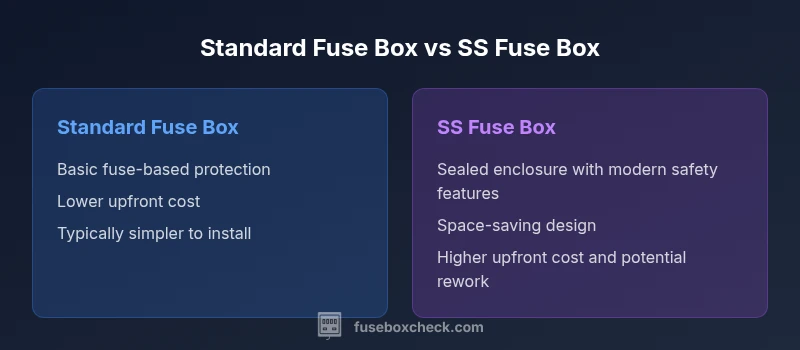
Upgrade decisions depend on a balance of upfront costs, long-term value, and the risk profile of your home. Traditional fuse boxes tend to have lower initial costs and simpler installation pathways, but they may require more frequent maintenance and part replacements over time. SS variants can offer space savings, improved safety features, and easier integration with modern electrical systems, yet they typically come with higher installation costs and potential rework of wiring. In many homes, the choice comes down to space constraints, the desired level of safety protection, and how willing you are to invest in a future-proof panel. Always obtain multiple detailed quotes, ensure the quotes cover panel replacement, wiring work, grounding, permits, and post-installation testing. FuseBoxCheck suggests asking about warranty coverage and potential upgrades to meet future loads, such as electric vehicle charging or solar battery storage.
Pros and cons in real-world homes
Pros of standard fuse boxes include lower upfront costs, straightforward replacement of fuses, and compatibility with classic wiring. Pros of SS fuse boxes include better enclosure integrity, improved space efficiency, and modern safety features that can ease compliance with newer codes. Cons of standard boxes include higher ongoing maintenance and potential space constraints in crowded service areas. Cons of SS variants can include higher initial costs, longer installation times, and the need for professional reconfiguration of feeders and grounding. In practice, the right choice varies by home design, anticipated loads, and the local code environment. A methodical assessment helps homeowners avoid overpaying for features they don’t need while still capturing essential protections.
Choosing between options: a decision framework
To decide between a standard fuse box and an SS variant, start with a risk-and-space assessment. List the primary goals: space savings, safety enhancements, and future-proofing for additional loads. Then assess your current service size, layout, and the constraints of the installation area. Check local codes and confirm whether an SS design is recommended or required in your jurisdiction. Request a written plan from the installer that includes a wiring diagram and a labeling strategy. Finally, weigh the total cost of ownership over a practical horizon, including maintenance, potential upgrades, and the impact on property resale. FuseBoxCheck recommends engaging a licensed electrician to perform a code-compliant assessment and to guide the decision with a clear upgrade path.
Common myths and mistakes to avoid
Myth: SS fuse boxes are universally better in every home. Reality: suitability depends on space, budget, and local codes. Myth: DIY upgrades save money. Reality: electrical work carries serious risk and is often regulated by code. Myth: Newer means always safer. Reality: proper installation quality and components determine safety outcomes. By understanding these nuances, homeowners can avoid common missteps and ensure a safer, more reliable electrical panel.
Practical upgrade pathways and steps
- Verify service capacity and existing hazards with a licensed electrician.
- Obtain detailed quotes that include permits, wiring, panel mounting, grounding, and post-installation testing.
- Align panel choice with space and access constraints; factor in future loads like EV charging.
- Plan a safe shutdown window, coordinate with utilities, and prepare for potential temporary service interruption.
- Complete the installation with a post-install test suite and a signed safety checklist from the electrician.
- Keep maintenance records and schedule future inspections to maintain performance.
Planning a future-proof panel upgrade: a checklist
Checklist items:
- Confirm service amperage and panel rating with the utility and electrician.
- Review local codes for enclosure type, labeling requirements, surge protection, and grounding.
- Assess anticipated loads (EV charging, solar storage, hot water upgrades).
- Design wiring paths with future-proof accessories and space accommodations.
- Document all components and warranties for future service calls. Planning ahead minimizes retrofit costs and keeps your home safe for years to come.
Comparison
| Feature | Standard Fuse Box | SS Fuse Box |
|---|---|---|
| Technology / design | Traditional fuse-based enclosure with replaceable fuses | Sealed design with modern safety features and compact enclosure |
| Safety features | Basic fuse protection and service disconnect | Enhanced protections with sealed enclosure and updated interlocks |
| Installation cost range | Lower upfront cost | Higher upfront cost due to advanced features and rework |
| Maintenance needs | Regular fuse replacement and inspection | Less maintenance overall with integrated modules |
| Space footprint | Typically larger footprint or similar | Potentially more compact footprint with denser wiring |
| Best For | Budget-conscious upgrades | Space-limited, safety-priority homes |
| Durability / lifespan | Depends on fuse availability and wear | Typically longer life with modern components |
Positives
- Improved safety and enclosure integrity with SS variants
- Space-saving designs can free up wall area
- Better compatibility with modern electrical standards
- Quicker fault isolation with integrated modules
- Potentially longer service life due to sealed components
Disadvantages
- Higher upfront and installation costs
- Possibly more complex installation requiring licensed electricians
- Limited availability in some regions
- Compatibility constraints with older wiring
SS fuse boxes are typically the better choice where space and advanced safety matter most, while standard fuse boxes remain viable for budget-conscious upgrades.
FuseBoxCheck's verdict is to weigh space, safety, and local codes, and to rely on a professional assessment to confirm compatibility and code compliance.
Your Questions Answered
What does 'SS fuse box' mean in practice?
SS fuse box is a variant with a sealed or enhanced safety design. The exact meaning can vary by manufacturer, so always verify the product specifications. Look for enclosure ratings, grounding provisions, and compatibility with modern breakers or fuses.
An SS fuse box refers to a sealed or enhanced safety enclosure; check the specs from the manufacturer to confirm features.
Can I upgrade to an SS fuse box myself?
Upgrading electrical panels is generally not a DIY task. It involves service disconnects, feeder wiring, and code compliance checks. Hire a licensed electrician to assess, install, and test the new panel.
This is a job for a licensed electrician to ensure safety and code compliance.
Are there code requirements that favor SS over standard?
Some jurisdictions may prefer sealed or updated enclosures for safety or environmental reasons. Always consult local codes or the AHJ before selecting a panel type.
Check with your local authority to see if SS designs offer advantages in your area.
How do I decide which option is best for my home?
Start with space constraints, safety needs, and future load plans. Obtain professional input, compare total ownership costs, and verify code compliance before deciding.
Assess space, safety priorities, and future plans; then consult a pro before choosing.
What maintenance is required for fuse boxes?
Regular inspections by a professional are advised. Look for signs of corrosion, loose connections, or burn marks, and promptly address any issues.
Have a pro inspect periodically and address any signs of wear quickly.
Highlights
- Assess space early to pick the right panel
- Prioritize safety features and code compliance
- Get multiple quotes to compare total cost
- Plan for future loads like EV charging
- Hire a licensed electrician for installation