Fuse Box and Meter: A practical comparison for safe home electrical service
Compare fuse box and meter configurations with a modern breaker panel. This practical guide covers safety, maintenance, cost factors, and upgrade considerations for homeowners troubleshooting electrical service.


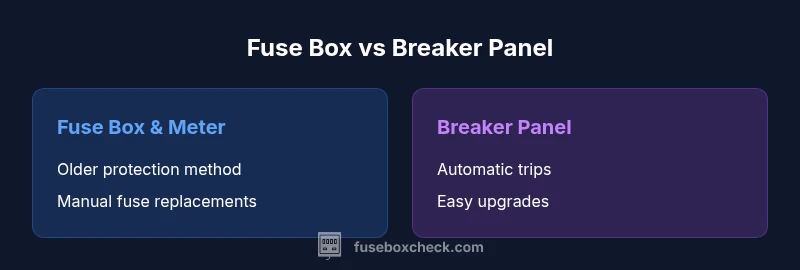
According to FuseBoxCheck, the fuse box and meter describe the older fuse-based service path, while a modern breaker panel simplifies maintenance and improves safety. The Meter location remains a fixed service entry, so the choice mainly affects daily operation and upgrades. This quick comparison highlights the practical differences homeowners should weigh.
Why fuse box and meter configurations matter for safety and reliability
The arrangement of your home's fuse box and meter is more than a convenience choice; it defines how safely electrical faults are detected and isolated, and how quickly power can be restored after a disruption. In a traditional setup, the fuse box contains cartridge fuses that physically blow to interrupt current, while the meter sits upstream as the utility's measurement and service point. When risk factors rise—aging insulation, outdated wire sizes, or limited space—problems cascade: nuisance trips, delayed disconnections, and higher chances of arc faults. FuseBoxCheck emphasizes that homeowners should view the service entrance as a system, not a single component. Regular inspections by a qualified electrician help catch signs of wear, degraded connections, and mismatches between loads and the service available. By understanding how the fuse box and meter interact, you can plan safer upgrades, plan for future loads, and reduce the likelihood of unexpected outages or electrical fires.
Core differences: fuses vs breakers
At the heart of the decision between a fuse box setup and a modern breaker panel are two fundamental protection mechanisms. Fuses rely on an element that melts when overcurrent occurs, interrupting the circuit but leaving the rest of the device live until a fuse is replaced. Breakers, by contrast, use an electromechanical switch that trips automatically in fault conditions and can be reset once the fault is cleared. This distinction affects daily operation, maintenance, and safety posture. Breakers provide faster, more predictable interruption, clearer trip indicators, and easier service readability for homeowners. They also support more sophisticated wiring arrangements and larger service capacities. For many households, upgrading to a breaker panel translates into a more manageable electrical system with better protection for sensitive electronics, HVAC equipment, and electric vehicle charging. However, upgrades require careful planning to avoid service interruptions and to align with local codes and the utility’s requirements. FuseBoxCheck notes that the decision should hinge on safety, reliability, and future load considerations.
Meter placement and service entry considerations
The meter's position in the service entry shapes how you access the main disconnect, how feeders run to the panel, and how upgrades are performed. In many homes, the meter sits outside or on an interior wall near the main panel; the fuse box variant often places the service disconnect directly at or near the meter. When you upgrade to a modern breaker panel, you may still need to coordinate with the utility to ensure the service entrance conductors, grounding electrode system, and main disconnect comply with current codes. In some jurisdictions, the upgrade is treated as a service upgrade rather than a simple panel swap, which can affect permit requirements, inspection steps, and scheduling. Understanding the service entry layout helps you plan minimal downtime, maintain safe conditions, and avoid inadvertently violating clearance or accessibility rules.
Upgrading path: planning, permits, and utilities
Upgrading from a fuse box to a breaker panel is a multi-step project that typically starts with a site assessment and load calculation. A licensed electrician assesses existing wiring, panel space, grounding, and whether service capacity is sufficient for anticipated loads, such as EV charging or heat pumps. Permits are usually required, and some upgrades may necessitate utility coordination to ensure the meter and service drop remain within code. The planning phase should also address wiring modernization, possible replacement of the service conductors, and proper labeling of circuits. Documenting the change for insurance and future resale is prudent. While the work can be extensive, a well-planned upgrade reduces the risk of nuisance trips, improves fault detection, and positions the home for continued safety with evolving electrical demands.
Cost implications and long-term value
Cost considerations for fuse box vs breaker panel upgrades extend beyond the initial price tag. Upgrading typically involves labor, panel purchase, inspection fees, and potential service reinforcement. While a fuse box may seem cheaper upfront, continued maintenance, fuse replacements, and the risk of unplanned outages can add up over time. A breaker panel offers clearer fault indicators, easier expansion, and compatibility with newer devices, often resulting in better long-term value. Local codes and utility requirements influence the overall expense, and some jurisdictions offer incentives for safety upgrades in older homes. FuseBoxCheck recommends obtaining multiple written quotes, clarifying whether permit and utility costs are included, and confirming that the contractor will coordinate with the utility for service interruptions. A carefully scoped plan protects you from surprise charges and ensures the upgrade aligns with current safety standards.
Load calculation and panel capacity
Accurately estimating load is essential before choosing a panel type or upgrading. A fuse box with aging wiring and limited spare spaces may not meet modern demand, particularly if you plan to add EV charging, climate control upgrades, or a shop inverter system. A professional will perform a load calculation that considers classic branch circuits, essential appliances, and future expansions, then translate that into appropriate panel size and breaker arrangements. The results guide decisions about service amperage, conductor sizing, and whether a subpanel is warranted for detached structures or new extensions. Understanding panel capacity also helps prevent nuisance trips and overheating, which are common signs of an undersized service. A well-mated panel and service entry set the stage for safe operation and longer equipment life.
Wiring and conduit considerations
Beyond the main panel, the condition of the wiring and conduit path influences upgrade feasibility. Older homes may feature aluminum service conductors, knob-and-tube wiring, or undersized feeders that require replacement or remediation before a panel upgrade. In many cases, a modern breaker panel can be installed without changing every existing circuit, but some rewiring or conductor replacements may be unavoidable to meet current wiring standards and insulation requirements. Ensure that grounding electrodes, bonding, and neutral practices comply with the National Electrical Code (NEC) and any local amendments. An experienced electrician will document the wiring changes, provide a clear wiring diagram, and test the system thoroughly after installation to verify proper operation and safety margins.
Compatibility with modern devices and electric vehicles
New home technology drives demand for higher load capacity and smarter monitoring. A fuse box and meter arrangement often struggles to keep pace with modern devices such as high-efficiency heat pumps, EV chargers, and whole-house energy management systems. A breaker-panel solution is typically more adaptable to future loads, with spaces for dedicated circuits and better fault isolation. When planning upgrades, consider future needs like night-time EV charging, solar integration, or battery storage. The goal is a system that remains safe, scalable, and compatible with smart meters and demand-response programs. FuseBoxCheck notes that many homeowners benefit from a panel designed with modular expansion in mind, ensuring the service can grow with evolving energy needs while maintaining clear labeling and accessibility.
DIY vs professional upgrade: when to call a licensed electrician
Electrical work at the service entrance carries significant safety and legal implications. While minor maintenance tasks may be suited for DIYers with specific training, major upgrades, panel swaps, and utility coordination require a licensed electrician. A professional will confirm permit requirements, ensure bonding and grounding are correct, verify that conductors meet code, and coordinate service interruptions with the utility. Viewing the upgrade as a collaborative process with clear milestones—site survey, load calculation, permit filing, inspection, and final testing—reduces risk and accelerates project completion. FuseBoxCheck emphasizes safety and code compliance as non-negotiable when handling fuse box and meter upgrades.
Common myths about fuse boxes and meters
Many homeowners believe that older fuse boxes are inherently unsafe or that upgrades always require a full house rewire. In reality, the risk depends on your specific wiring age, protection type, and maintenance history. Some myths suggest that meters cannot be relocated or that service drops limit what you can upgrade; while certain restrictions exist, many upgrades are feasible with proper coordination. Another frequent misconception is that breakers are less reliable than fuses; modern breakers have design advantages that improve safety and ease of use. Debunking these myths helps homeowners approach upgrades with evidence-based planning rather than fear or rumor.
Maintenance and inspection tips to keep the system safe
Regular maintenance is a cornerstone of electrical safety. Schedule annual inspections, especially in homes with old wiring or frequent outages. Visual checks for signs of overheating, discoloration around panel covers, and loose connections are essential. Keep panel doors accessible, label circuits clearly, and test emergency disconnects if present. When adding circuits for new loads, ensure the panel has available spaces and that the conductors have appropriate sizing. For fuse boxes, have a plan for fuse replacement tools and spare fuses. For breaker panels, ensure main disconnects operate smoothly and that ground fault/arc fault protection is installed where required. Proactive maintenance reduces the risk of unexpected failures and extends equipment life.
Red flags that require immediate attention
Certain conditions demand urgent attention from a licensed electrician. Smoking odors near the panel, scorch marks on breakers, buzzing sounds, or frequent tripping indicate serious issues. If you notice a warm or warming panel, corroded or loose connections, or a history of flickering lights, stop using the area and seek professional service. Also, if the meter or main disconnect appears corroded or has damaged insulation, treat it as a high-priority safety risk. Addressing these red flags promptly can prevent more severe problems and protect your home and occupants.
Comparison
| Feature | Fuse box and meter | Breaker panel with meter |
|---|---|---|
| Safety mechanism | Fuses interrupt with a blown element; faults may stay live until replacement | Breakers trip automatically and clearly indicate the fault; easy reset |
| Upgrade readiness | Limited upgrades; often requires complete panel replacement | High upgrade compatibility; supports modular expansions |
| Maintenance needs | Regular fuse checks and replacements; cautious handling of live parts | Periodic breaker testing and visual inspections |
| Space/layout impact | Older fuse boxes can be bulky; meter location varies by home | New panels are modular and neater; often better space efficiency |
| Future-proofing | Limited capacity for modern loads without significant work | Excellent for future loads (EVs, HVAC, solar) with expansion capacity |
| Installation complexity | Higher due to fuse removal and wiring changes | Moderate; standard electrical work with utility coordination |
| Service interruptions | Fuses may require outages for replacement | Outages may occur during panel upgrade; planned with utility |
| Smart meter compatibility | Older setups may require adaptation for smart meters | Designed for modern utility interfaces and metering |
Positives
- Potentially lower upfront costs if existing equipment remains usable
- Fewer structural changes to the home when staying with a fuse box
- Simpler labeling and circuit understanding where space is constrained
- Clear separation of older systems that some homes still rely on
Disadvantages
- Higher long-term maintenance with fuse replacements and burn risk
- Limited protection clarity during faults without automatic trip indicators
- Less scalable for modern loads and future expansions
- Greater difficulty coordinating with modern utility interfaces
Breaker panel upgrades generally win for safety and future-proofing
Upgrading from a fuse box to a breaker panel improves fault detection, supports larger loads, and simplifies future expansions. Coordinate with the utility and a licensed electrician to minimize downtime and ensure code compliance.
Your Questions Answered
What is the practical difference between a fuse box and a breaker panel?
A fuse box relies on fuses that blow to interrupt current, while a breaker panel uses switches that trip automatically. Breakers provide faster clear protection, easier troubleshooting, and greater future compatibility. The choice affects maintenance needs and upgrade potential.
Fuses interrupt with replacement, while breakers trip automatically and reset after faults, making modern panels safer and easier to manage.
Can I upgrade from a fuse box to a breaker panel without moving the meter?
In many cases you can upgrade the panel without relocating the meter, but you may need utility coordination, permits, and potential service conductor changes. A licensed electrician can confirm feasibility for your home.
Yes, upgrades are often possible without moving the meter, but permits and utility coordination are usually required.
What factors drive the cost of upgrading fuse box and meter to a breaker panel?
Costs depend on panel type, wiring condition, permit and utility requirements, and whether grounding or service conductors must be updated. Have a licensed electrician provide a written scope and range after a site visit.
Costs vary with panel type, wiring condition, and required permits; get a detailed quote from a licensed pro.
Is upgrading required by electrical codes?
Modern codes emphasize safe service disconnects and proper grounding. An upgrade is often advisable to meet current standards, and local authorities may specify requirements for service entrances and meter coordination.
Code favors safe, up-to-date panels; check local regulations with a licensed electrician.
How long does an upgrade typically take?
Typical upgrades take a day or two, depending on access, permit processing, and utility scheduling. A detailed plan helps minimize downtime and keeps work within expected timeframes.
Most upgrades take a day or two; coordinating permits and the utility is common.
Will upgrading affect home insurance?
Upgrading to a code-compliant panel can influence insurance requirements. Notify your insurer, provide documentation, and ensure the work is properly inspected to protect coverage.
Tell your insurer about the upgrade and keep receipts; coverage can change with code-compliant work.
Highlights
- Assess current panel and meter setup before planning upgrades
- Fuses vs breakers: protection and maintenance contrast matters
- Expect permits and utility coordination for service upgrades
- Plan for future loads like EV charging and solar integration
- Engage a licensed electrician for a safe, code-compliant upgrade
- Schedule regular maintenance to extend system life