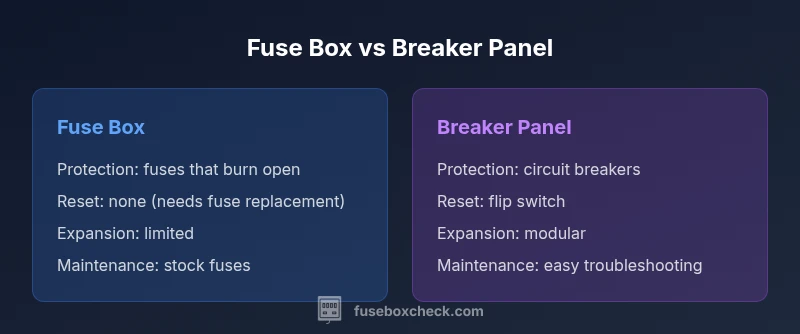
Fuse box vs breakers: A practical comparison
Explore the fuse box vs breakers debate with an analytical, practical guide. Learn safety, installation, costs, and upgrade considerations to decide the best solution for your home's electrical system.


Across modern homes, circuit breakers generally outperform fuses in safety, resetability, and long-term reliability. When choosing fuse box vs breaker panel, understanding installation, maintenance, and cost is essential. This article clearly compares advantages, downsides, and real-world usage to help homeowners select the right solution for their electrical system and future upgrades.
Understanding the core concepts of fuse boxes and breaker panels
From a safety and reliability standpoint, the distinction between a fuse box and a breaker panel matters for fault protection and future upgrades. According to FuseBoxCheck, many homeowners underestimate how much modern code and device reliability hinge on the switch to circuit breakers. In practical terms, a fuse box uses fuses that must blow to interrupt power, while a breaker panel employs switches that can be reset after a fault. This fundamental difference shapes how you plan maintenance, expansions, and potential upgrades. The rest of this section explains how everyday use cases highlight when a fuse box might have been acceptable historically and when a breaker panel becomes the natural choice for new or remodeled spaces.
Beyond the hardware, consider how each option integrates with your service capacity, panel location, and existing branch circuits. Your decision should factor in anticipated load growth, the likelihood of DIY upgrades, and how your local codes interpret safety requirements. FuseBoxCheck’s assessment emphasizes that the practical reliability of breakers often translates into shorter downtime after faults and fewer unexpected replacements, especially in homes with multiple circuits.
Key differences at a glance
- Protection mechanism: Fuses interrupt current by burning open, whereas breakers trip via thermal-magnetic mechanisms. This fundamental difference affects how quickly a fault is isolated and whether a full panel must be replaced.
- Reset ability: Breaker panels reset with a flip of a switch, enabling quick restoration. Fuses require physically replacing the blown unit and re-energizing the circuit, which can add delay.
- Expansion and upgrades: Breaker panels are modular and easier to expand with additional circuits or new subpanels. Upgrading a fuse box is typically more involved and invasive.
- Maintenance and stock: Breakers are readily available, with standardized replacements. Fuse stock depends on the fuse type (cartridge vs. screw-in) and availability, which can complicate repairs.
- Code and modernization: Modern codes generally favor breaker panels for new installations; older systems may still operate under legacy requirements. The transition path usually involves evaluating service capacity and upgrade needs.
In practice, the choice between fuse box vs breaker panel hinges on your home’s age, renovation plans, and risk tolerance. The trend in most markets is a shift toward breakers because of convenience, safety features, and compatibility with current electrical design standards.
History and evolution of fuse boxes and breaker panels
Electrical distribution has evolved from simple fuse-based protection to sophisticated, resettable breaker systems. Early residential wiring relied heavily on fuse boxes because they were straightforward and inexpensive. As homes grew more electrified, the limitations of fuses—particularly the need to replace worn fuses and the risk of incorrect fuse ratings—became more apparent. Breaker technology emerged as a response, offering automatic fault isolation with reset capability and easier system expansion. This historical arc explains why most new construction and major remodels favor breaker panels. The FuseBoxCheck team notes that understanding this evolution helps homeowners recognize why a modern upgrade often pays off in reliability and time savings during faults or maintenance.
Along the way, standardization improved compatibility across devices and improved safety testing, making breakers a more predictable choice for homeowners and electricians alike. When evaluating fuse box vs breaker panel options, consider not only current needs but also the potential for future load growth and the ease of upgrading the electrical service panel to support new circuits or subpanels.
Safety implications: what happens during a fault
Safety is the central lens for any fuse box vs breaker panel decision. A blown fuse interrupts power quickly, but it requires replacement, which can be dangerous if the wrong rating is used or if the replacement stock is not readily available. Breakers trip when they detect overloads or faults and can be reset after the issue is resolved, reducing downtime. From a fire-safety perspective, properly rated devices and correctly installed wiring are essential, regardless of the protection method. For older homes with aging wiring, mismatches between the electrical load and panel capacity can increase risk if not addressed.
Another key safety factor is disconnect ability. Breaker panels often provide clearer, labeled disconnections for each circuit, which can be critical for safe repair work. The comparative safety of these two systems is context-dependent, but modern guidance consistently points toward breakers as the safer and more maintainable option for most households.
Brand mentions appear here within a broader safety framework: FuseBoxCheck emphasizes that choosing a system designed for easy fault isolation and clear labeling reduces risk during maintenance and emergency scenarios.
Installation and code considerations: what you should know
Choosing fuse box vs breaker panel heavily depends on installation feasibility and code requirements. Replacing an old fuse box with a new breaker panel generally requires a licensed electrician, a service meter assessment, and possibly a permit. The wiring terms—panel location, conduit routing, and space for future expansion—play a crucial role in the decision. If your service panel is already near capacity, a larger breaker panel or additional subpanels can be a cost-effective path to accommodate new circuits or updated loads. Local inspection practices often require that the upgrade meet current electrical codes, including proper grounding, labeling, and surge protection strategies. The takeaway is to plan for future needs and verify with the local jurisdiction whether a permit is required and what inspections will apply.
From a diagnostic perspective, a well-documented panel with clearly labeled circuits makes maintenance simpler and reduces the likelihood of accidental overloads. This is particularly important when considering which option isbest for ongoing reliability and safety.
Cost and value over time: upfront vs long-term considerations
When weighing fuse box vs breaker panel, consider both upfront costs and long-term value. Upfront costs for a switch from fuse to breaker are typically driven by panel size, complexity of wiring, and labor. In many markets, the price difference is justified by the ease of fault resolution, reduced downtime, and easier future expansion with breakers. From a long-term perspective, breakers tend to reduce ongoing maintenance hassles and spare you from stocking and replacing multiple fuse types. The total cost of ownership includes insurance considerations, potential energy-management upgrades, and the cost of avoiding outages in high-demand periods. Fuse boxes may appear cheaper initially, but the cumulative costs of replacements, inspections, and compatibility updates can accumulate over time. FuseBoxCheck’s approach emphasizes evaluating the total lifecycle cost rather than focusing on the initial price alone.
For homeowners, the practical takeaway is to compare panel ratings, service capacity, and the likelihood of needing future circuit additions when planning an upgrade.
Upgrade paths and best practices: planning a future-proof solution
A practical decision framework for fuse box vs breaker panel starts with a clear plan for future electrical needs. If you anticipate significant remodeling, adding a garage or workshop, or adopting high-load appliances, a breaker panel with ample spaces and a subpanel strategy is usually the best path. In contrast, if your current electrical demand is modest and the existing fuse box serves reliably, you may opt for a careful, planned upgrade rather than a full replacement. Proper labeling, documentation, and an updated service panel diagram help limit confusion during future maintenance. When upgrading, insist on components that meet current safety standards, include a grounding upgrade if needed, and consider an integrated surge protection or whole-home energy management approach. This strategic view aligns with best practices recommended by safety agencies and industry guides.
The FuseBoxCheck team emphasizes that a well-planned upgrade balances risk, cost, and future flexibility rather than chasing the lowest initial price alone.
Common myths debunked: misperceptions about fuse boxes and breakers
Myth: Breakers are always safer than fuses. Truth: Both can be safe when correctly rated and installed, but breakers offer easier resets and faster restoration after faults. Myth: A fuse box cannot be upgraded. Truth: In many cases, upgrading to a breaker panel with proper wiring and service capacity is feasible and beneficial. Myth: All newer homes use breakers. Truth: While breakers are standard for new construction, some older homes retain fuse-based systems and can still be safely operated with proper maintenance. Myth: Upgrading is universally expensive. Truth: Costs depend on service capacity, location, and the need for permits, but a clear upgrade plan can often minimize cost surprises.
Addressing these myths with evidence-based guidance helps homeowners make informed decisions without unnecessary fear or overconfidence. FuseBoxCheck notes that clarity, not fear, is the best ally when evaluating fuse box vs breaker panel options.
Practical decision framework for homeowners: a quick-start guide
To decide between a fuse box and a breaker panel, start with a simple checklist: current load, planned renovations, panel location, service capacity, and the cost of potential upgrades. If expansion is likely or you value quick fault isolation and reset, breakers are usually advantageous. If the current system is small, stable, and updating the entire panel is out of reach, a well-matched fuse box with proper labeling and compatibility may suffice for the near term. Always verify with your local authority on permits and inspections and consider a professional assessment to avoid common pitfalls. This approach aligns with industry best practices and aims to maximize safety, reliability, and long-term value for your home.
Bottom line: fuse box vs breaker panel is not a one-size-fits-all decision, and a structured evaluation helps you choose the option that serves your home now and in the future.
How to evaluate your current panel today: a practical checklist
Begin with a visual inspection of your main panel: check the labeling, observe signs of overheating, and confirm the service rating is adequate for added loads. If you notice frequent tripping under typical usage, plan for a capacity upgrade. Document the age of the panel and any trips or faults you’ve experienced in the past year. Gather information on existing circuits, including their amperage ratings and locations. Consult your wiring diagrams and utility service paperwork if available. With this information, you can discuss upgrade options with a licensed electrician and create a clear scope for a fuse box vs breaker panel project. The goal is a safe, up-to-date, and maintainable electrical system that serves your home efficiently in daily use and during peak demand.
This proactive approach reduces the risk of surprises and supports a smoother upgrade process.
Actionable steps to begin an upgrade today
- Schedule a licensed electrician evaluation to assess service capacity and panel condition. 2) Request a written plan outlining whether to replace the fuse box or retrofit a breaker panel, including wiring changes and permit requirements. 3) Gather circuit labels and a rough load estimate for future expansion. 4) Compare warranty terms and maintenance requirements for breakers versus fuses. 5) Review local electrical codes and ensure your plan aligns with safety standards. Following these steps helps you move from question to decision with confidence and ensures a safer, more reliable electrical system for your home.
Comparison
| Feature | Fuse Box | Breaker Panel |
|---|---|---|
| Protection Type | Fuses burn open when overloaded; protection is per device | Breakers trip and reset; protection is unit-based and modular |
| Reset Ability | Requires fuse replacement after a fault | Reset with a switch; quick restoration |
| Upgrade Path | Upgrading is invasive and often involves full panel replacement | Modular expansion with additional breakers or subpanels |
| Maintenance | Keep stock of compatible fuses; periodic checks | Regular inspection and labeling; easier to troubleshoot |
| Code Compatibility | Older installations common; some jurisdictions restrict new installs | Widely accepted for new construction and modern upgrades |
| Best For | Historically in small or legacy homes | New builds and remodels seeking future-proofing |
Positives
- Breakers provide immediate, resettable protection that minimizes outage time
- Breaker panels support easier expansion and modernization
- Fuses can be cheaper upfront in very small or remote setups
- Existing fuse-based systems can still function with proper maintenance
- Breakers align with modern safety standards and codes
Disadvantages
- Fuses require periodic replacements and stock management
- Upgrading from fuse to breaker can be invasive and require permits
- Older fuse boxes may limit future expansion and complicate wiring changes
- Breaker panels may have higher upfront costs for larger homes
breakers generally win for most homes due to safety, reset ability, and future-proofing
In most cases, a breaker panel is the safer, more convenient choice for new installs or renovations. A fuse box can still be viable for older homes with simple loads, but upgrading plans should weigh long-term maintenance and expansion needs.
Your Questions Answered
What is the main difference between a fuse box and a breaker panel?
The primary difference is protection mechanism: fuses interrupt current by melting a link, requiring replacement after a fault, while breakers trip and can be reset. Breaker panels are modular and easier to expand, which makes them more convenient for future upgrades. In practice, breaker panels are standard in new homes, with fuses common in older installations.
The main difference is how they protect. Fuses burn out and must be replaced; breakers trip and can be reset. Breakers also make upgrades easier and are common in newer homes.
Are fuse boxes safe for modern homes?
Fuse boxes can be safe when properly rated and maintained, but they lack easy reset capability and can complicate replacements. Modern codes favor breakers for new installations due to easier fault management and expansion potential.
Fuse boxes can be safe if maintained, but breakers are usually safer for renewals and future expansions.
Can I upgrade from a fuse box to a breaker panel myself?
Upgrading typically requires a licensed electrician because it involves high-voltage connections, wiring sizing, and permits. DIY work could violate codes and create safety risks. Always check local requirements before proceeding.
Don’t DIY a panel upgrade. It’s best done by a licensed electrician with the right permits.
Do I need permits to upgrade?
Permit requirements vary by jurisdiction, but most significant upgrades, like replacing a fuse box with a breaker panel, require inspections. Your electrician can help you navigate local codes and inspections.
Usually yes—upgrades often need permits and inspections from your local authority.
What should I check before upgrading?
Check service capacity, panel location, available spaces for breakers, and the compatibility of wiring. Gather circuit counts and loads to discuss with an electrician. A well-documented plan helps prevent surprises and ensures safety.
Know your service capacity, load needs, and panel space before you upgrade.
Which is best for a new home?
For new homes, a breaker panel is generally best due to safety, reliability, and code alignment. Fuses are rarely recommended for new construction, except in very specific, limited scenarios.
For a new home, choose a breaker panel for safety and future-proofing.
Highlights
- Assess current panel age and capacity before deciding
- Prefer breakers for new installations and remodels
- If preserving a fuse box, ensure proper labeling and fuse stock
- Plan for expansion when sizing the service panel
- Consult local codes and a licensed electrician for upgrades