Fuse Box vs Circuit Breaker: Pros and Cons in Home Electrical Care
An objective comparison of fuse boxes and circuit breakers for homeowners, detailing safety, maintenance, costs, and upgrade considerations to help decide on the right approach in 2026.


In a fuse box vs circuit breaker comparison, the real differences matter for safety, maintenance, and cost. For most homeowners, circuit breakers offer ongoing protection with easier resets and longer life, while fuses provide immediate, simple overcurrent protection but require replacement. The right choice depends on your panel type, local codes, and future renovation plans to guide a practical approach.
What fuse boxes and circuit breakers are
A fuse box houses fuses that interrupt power when overloaded, while a circuit breaker panel uses switches that trip open or trip closed to stop current flow. The phrase fuse box vs circuit breaker pros and cons captures the core choice in home electrical safety. In this guide, we compare the two options with a balanced, evidence-based perspective. According to FuseBoxCheck, understanding the basic concepts is the first step toward safer, smarter decisions. This section sets the stage by defining the two protective systems without bias, so homeowners can map their needs to actual features and limitations. Throughout the discussion, expect clear distinctions, practical considerations, and references to public safety guidelines.
Safety, risk, and how failures manifest
Both fuse boxes and circuit breaker panels are foundational to electrical safety, yet their failure modes carry different implications. A blown fuse removes power immediately but requires a manual replacement, potentially exposing a homeowner to hot components. Breakers trip and can be reset, reducing downtime but introducing the possibility of nuisance trips if the load calculations are off. The key safety questions are: what happens when overloads occur, how easy is it to restore power, and how does each option interact with modern safety devices like GFCI and AFCI protections. Understanding these dynamics helps you judge which system aligns with your risk tolerance and household load patterns.
Installation and compatibility: what to know
Older homes often rely on fuse-based protection, while newer builds trend toward circuit breaker panels. Changing a fuse box to a breaker panel may require panel upgrades, wiring assessment, and adherence to local codes. Compatibility with existing electrical service, panel space, and conductor sizing matters. Before any upgrade, confirm whether your service entrance, meter, and main disconnect can support a modern breaker system. The decision should consider not only current needs but also potential future upgrades, such as smart home devices or expanded circuits.
Maintenance demand and lifespan expectations
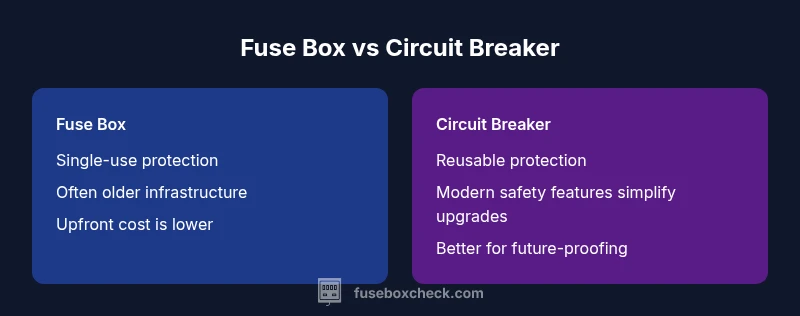
Fuses are single-use components; once they blow, they must be replaced. Breakers, by contrast, offer reusable protection and can be reset after a trip. This difference translates into maintenance cadence: fuse boxes can incur more frequent consumable replacements, while breaker panels emphasize panel health checks and periodic testing of trips. Practical maintenance involves visual inspection, testing with a proper tester, and ensuring that the panel enclosure is accessible and labeled. When maintenance habitually disrupts life, breakers may offer a smoother experience with fewer interruptions.
Cost considerations and value over time
Budgeting for fuse boxes vs circuit breakers involves upfront cost considerations and long-term value. Fuses tend to be cheaper to install at the outset, but ongoing replacements can accumulate over the years, especially in active households with heavy electrical use. Breaker panels may require a larger initial investment due to panel and wiring work, but the long-term operational costs tend to be lower because of reusability and compatibility with additional safety features. In many cases, homeowners assess total cost of ownership rather than upfront price alone.
Reliability in fault conditions: downtime and reset practicality
The practical reliability of each approach depends on the scenario. A single blown fuse stops power immediately to the affected circuit, which can be advantageous for a quick fix but creates downtime. Breakers trip when overloaded and can restore power quickly after a nuisance trip, reducing downtime but occasionally masking a larger problem if load calculations are inaccurate. A balanced assessment weighs the likelihood of nuisance trips against the convenience of instant restoration after addressing the root cause.
Real-world scenarios: old homes vs modern builds
In older homes with legacy wiring and limited panel space, a fuse box may still be acceptable, provided the system meets current safety standards and local codes. For new builds or major renovations, a circuit breaker panel is usually preferable due to superior safety features, ease of maintenance, and better support for modern devices. The choice should reflect the expected load growth, planned upgrades, and the homeowners' tolerance for downtime during service work.
Environmental and efficiency considerations
Electrical protection decisions influence energy management and safety device compatibility. Breaker panels facilitate integration with modern safety devices like GFCI and AFCI, improving overall home safety. Fuses can still function effectively in simple circuits but may limit the ability to leverage advanced protective technologies. Homeowners who emphasize energy efficiency and smart-home compatibility often lean toward breakers for future-proofing, while those working with vintage installations may prioritize preserving existing fuse-based protection.
Regulatory guidance and building-code implications
Code requirements vary by jurisdiction, but safety and reliability generally drive the trend toward circuit breakers in new installations. Local building departments can provide guidance on whether an upgrade is needed during renovations or if the existing fuse-based system remains permissible. It is essential to obtain permits as required and have electrical work inspected to ensure compliance with current electrical codes and safety standards.
Upgrading paths and professional support options
If you plan to upgrade from a fuse box to a circuit breaker panel, involve a licensed electrician to evaluate service capacity, wiring, and panel location. The upgrade path may include service conduit inspection, meter base compatibility, and potential service-entry upgrades. For homeowners with limited capacity for DIY, professional installation minimizes safety risks and ensures compliance with electrical code requirements.
Quick-start decision framework and practical checklist
Create a simple framework: identify current system type, assess home age and renovation plans, check compatibility with safety devices, compare upfront costs with long-term value, and confirm local code requirements. A practical checklist helps you decide whether to maintain the status quo, upgrade to a circuit breaker panel, or consider a mixed approach when appropriate. This approach aligns with FuseBoxCheck’s emphasis on safety, clarity, and actionable steps for homeowners.
Comparison
| Feature | Fuse Box | Circuit Breaker Panel |
|---|---|---|
| Protection mechanism | Fuses interrupt by metal link melting | Breakers trip mechanically or thermally/ electronically |
| Reset after event | Requires fuse replacement after a blow | Can be reset after a trip |
| Service life | Consumable components; replaced after each failure | Reused protection with occasional maintenance |
| Safety device integration | Basic protection; limited integration with modern devices | Easily integrates with GFCI/AFCI and smart panels |
| Installation considerations | May fit older wiring; minimal modernization | Often requires panel upgrade and wiring assessment |
| Best for | Older homes with existing fuse boxes (or no planned renovations) | New builds or major renovations seeking modern safety features |
Positives
- Circuit breakers offer reusable protection and easier power restoration after trips
- Breakers integrate with modern safety devices (GFCI/AFCI) for enhanced protection
- Breakers generally support longer service life with less downtime from replacements
- Upgrade potential aligns with current codes and future-proofing
Disadvantages
- Fuses provide simple, direct protection and may have lower initial cost
- Fuses require manual replacement after each blow, causing downtime
- Older fuse-based systems may need more frequent maintenance and parts
- Panel upgrades can be expensive in older homes with limited space
Circuit breakers generally offer better safety, maintenance, and future-proofing; fuse boxes remain viable only in select older-home contexts.
Choose breakers for ongoing protection, easier resets, and code compatibility. Choose fuses only if maintaining an existing fuse-based system with no planned upgrades and limited space for a full panel replacement.
Your Questions Answered
What is the main difference between fuse boxes and circuit breaker panels?
The main difference is in how protection is achieved and maintained: fuses interrupt power by melting a link, requiring replacement, while breakers trip and can be reset, offering reusable protection and easier maintenance. Both aim to prevent overcurrents and electrical fires, but breakers integrate more readily with modern safety features.
The main difference is that fuses are single-use and require replacement after a fault, while breakers trip and can be reset, offering easier maintenance and better integration with modern safety features.
Can I replace a fuse box with a circuit breaker panel in an older home?
Yes, but it typically requires a professional assessment of service capacity, wiring condition, and panel location. The upgrade may involve service feeder upgrades, panel replacement, and adherence to current codes, which can be a substantial project depending on the existing infrastructure.
Yes, but it usually needs a licensed electrician to check service capacity and local codes, and it may involve more extensive wiring work.
Are fuses safer than breakers?
Neither is inherently safer in all situations; both provide overcurrent protection, but breakers offer easier reset and better compatibility with modern safety devices, while fuses can be simpler and more predictable in some older installations. Safety hinges on proper sizing, installation, and maintenance.
Not inherently safer—both protect against overcurrents. Breakers are easier to reset and work with modern safety devices, while fuses are simple but require replacement.
How do I decide whether to upgrade to a circuit breaker panel?
Evaluate the age of your home, planned renovations, panel space, and whether you need modern safety features. If you expect load growth or want easier maintenance, upgrading to a breaker panel is typically advantageous.
Consider your home’s age, planned renovations, space, and whether you want modern safety features and easier maintenance.
Do local codes require upgrading to breakers?
Code requirements vary by jurisdiction. Some areas allow existing fuse boxes to remain if they are safe and up to code, while others encourage upgrading during renovations. Always consult your local building department and get an inspection when in doubt.
Codes vary by location; some allow fuse boxes if safe, others encourage upgrading during renovations. Check with your local building department.
What maintenance is required for breakers?
Regular inspections, testing trips, and ensuring accessible panels are key. If a breaker trips frequently, a professional should assess loading and potential faults. Clean and label circuits to maintain clarity and safety.
Test trips regularly, inspect for wear, and have loads checked if trips are frequent. Keep the panel accessible and well-labeled.
Highlights
- Prioritize safety features and future-proofing with breakers
- Expect higher upfront costs for a panel upgrade but lower long-term maintenance
- Fuses may still fit older homes under code-compliant, limited-scope renovations
- Plan for professional assessment to ensure panel compatibility and compliance
- Check local codes and obtain permits when upgrading