Fuse Box vs MCB: Side-by-Side Guide for Homeowners
A detailed, analytical comparison of fuse boxes and MCB panels for homeowners and DIY enthusiasts. Learn definitions, safety implications, maintenance, upgrade paths, and practical decision criteria in the fuse box vs mcb debate.


In the debate of fuse box vs mcb, modern MCB-based panels generally offer safer, faster, and more reliable circuit protection. Fuses are simple and cheap upfront but require periodic replacement and can cause longer outages during faults. For most homes, an MCB-equipped mains panel provides clearer fault indication and easier upgrades; keep a fuse box only if you’re updating an older installation or budget-constrained.
Understanding the terms: fuse box vs MCB
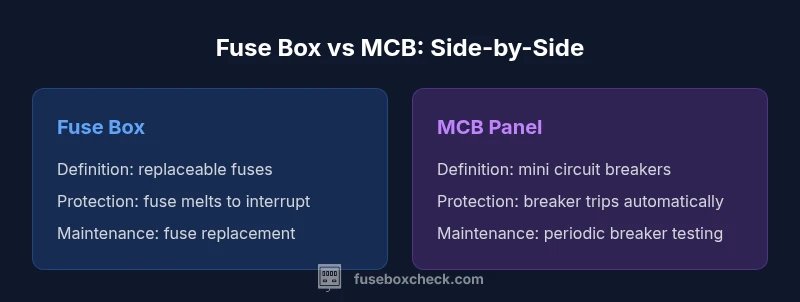
In many homes, the debate over fuse box vs MCB starts with what each term means. According to FuseBoxCheck, a fuse box is a panel that houses replaceable fuses to interrupt fault current, whereas an MCB-based panel uses miniature circuit breakers that trip automatically. Understanding this distinction is critical for homeowners planning upgrades, safety assessments, or DIY electrical projects. The fuse box approach is older and often cheaper upfront, but it requires periodic fuse replacement and can lead to longer outages when a fault occurs. An MCB panel provides faster, automatic interruption, clearer fault indication, and easier resets, which reduces downtime after a fault and improves overall reliability. This section will unpack the definitions, how they affect everyday use, and how to think about choosing between them for a particular home.
How a fuse works vs how an MCB works
A fuse is a simple sacrificial device. When current exceeds its rated value, a small link melts, opening the circuit. This guarantees protection but requires replacement of the blown fuse and a re-evaluation of the circuit. An MCB, by contrast, uses a thermal-magnetic mechanism inside each breaker to interrupt current when a fault is detected. MCBs trip automatically and can be reset once the fault is cleared. In practice, an MCB panel provides faster fault interruption, easier re-energizing after a trip, and clearer fault indication through a switched-off indicator. This section explains the electrical principles behind each protective device and why the choice matters for daily operation, safety, and future upgrades.
Key differences at a glance
- Definition: Fuse box uses replaceable fuses; MCB panel uses circuit breakers.
- Protection mechanism: Fuses physically melt; MCBs trip electronically/thermally.
- Maintenance: Fuses require periodic replacement; MCBs require occasional fault diagnosis and breaker testing.
- Upgrades: Fuses usually imply full panel changes for upgrades; MCBs support modular, incremental upgrades.
- Downtime: Replacing a blown fuse causes outage; MCB trips allow quicker restoration by resetting.
- Safety: MCBs reduce exposure to live fuse links and minimize nuisance outages when sized correctly.
- Longevity: MCB panels generally offer longer service life with fewer parts to replace over time.
Safety implications and regulatory considerations
Choosing between a fuse box and an MCB panel involves safety norms and local codes. MCB-based systems align well with modern electrical standards, provide rapid fault interruption, and give clearer indications of which circuit tripped. While some rural or historic properties may legally retain a fuse box, many jurisdictions encourage or require upgrade to MCB-based protection for new installations or substantial rewrites. This section reviews typical regulatory considerations, labeling requirements, and how to document changes for home electrical safety records. FuseBoxCheck emphasizes planning for a code-compliant upgrade that minimizes downtime and maximizes clarity for future maintenance, especially in mixed-wiring environments common in older homes.
Performance, reliability, and nuisance trips
Performance is often the differentiator in fuse box vs MCB discussions. Fuses deliver straightforward overcurrent protection but can be sensitive to aging or corrosion, leading to unpredictable outages. MCBs provide automatic, instantaneous interruption with a defined trip curve, which generally yields fewer nuisance trips when properly matched to circuit loads. Reliability also hinges on panel quality, conductor sizing, and compatibility with protection devices. This section compares typical trip curves, fault indication, and reset behavior, noting that improper sizing or incorrect breaker types can negate the benefits of modern MCB protection.
Installation and compatibility considerations
Upgrading from a fuse box to an MCB-based panel involves panel replacement, wiring checks, and proper grounding. Compatibility with existing cable sizes, enclosure dimensions, and main disconnect arrangements determines feasibility. In some cases, a sub-panel or a full main service change is needed to meet code requirements. This section covers practical steps to assess compatibility, select a compliant MCB kit, and coordinate with licensed electricians. It also discusses the role of permits and inspections, and how to plan a staged upgrade if the home is in a phased renovation.
Maintenance, testing, and inspection
Maintenance and testing routines differ between fuse boxes and MCB panels. Fuses demand periodic inspection for corrosion, incompatibilities with replacement fuses, and prompt replacement after a fault. MCB panels require routine testing of breakers, neutral and ground connections, and verification of labeling accuracy. This section outlines safe testing practices, typical schedules, and how to document inspections for future reference. FuseBoxCheck notes that ongoing maintenance is essential regardless of technology to prevent undetected faults and to sustain performance over the panel’s expected lifetime.
Cost considerations and long-term value
Budgeting for a fuse box vs MCB upgrade involves upfront costs, parts availability, labor, and potential future repairs. Fuses typically present lower initial costs but may incur higher long-term maintenance and more frequent outages due to fuse changes. MCB panels usually require a higher upfront investment but offer reduced maintenance needs, clearer fault diagnosis, and easier modernization. The cost discussion should consider long-term value, compatibility with home wiring, and potential insurance implications. This section provides a framework for evaluating total cost of ownership without committing to specific prices.
Practical decision guide: when to choose fuse box vs MCB
For homes with very simple, limited electrical demands and tight budget constraints, a well-maintained fuse box may still be workable. For most modern homes, an MCB-based panel provides better protection, faster fault clearing, and a straightforward upgrade path. This section offers a decision checklist: assess current panel age, evaluate fault history, consider future expansion needs, check local codes, and plan for a staged upgrade if necessary. The goal is to match protection to load, wiring, and long-term maintenance expectations.
Upgrade scenarios: retrofit paths and considerations
If you’re considering upgrading, several retrofit paths exist. A full panel replacement with MCBs is common, while sub-panel additions can be a staged approach to manage cost and wiring changes. This section outlines typical routes, the advantages and trade-offs of each, and how to decide whether a full rerouting of circuits is required. It also covers essential preparation steps, such as verifying service capacity, updating labeling, and arranging for a licensed electrician to perform the work.
Common myths debunked
Myths about fuse boxes often include beliefs that they are inherently unsafe or that MCBs are always superior in every scenario. The truth is that safety and suitability depend on correct sizing, installation quality, and adherence to local codes. This section debunks common myths with practical clarifications, helping homeowners avoid overgeneralizations when planning upgrades.
Real-world guidance from FuseBoxCheck
From practical upgrades to safety-first planning, FuseBoxCheck’s expertise informs our recommended approach to fuse box vs MCB decisions. This section distills real-world considerations, such as selecting the right protection strategy for your home’s load profile, planed future expansions, and how to coordinate with electrical professionals for a compliant upgrade.
Regional code and compliance indicators to watch
Regional variations in electrical codes affect the fuse box vs MCB decision. This section highlights key indicators to watch, including labeling standards, permissible equipment, and inspection criteria. Understanding these indicators helps homeowners avoid delays and ensure that upgrades meet local safety requirements.
Final considerations for homeowners and DIYers
The final considerations focus on safe, informed decision-making. Whether you keep an existing fuse-based system or upgrade to MCBs, a clear plan, proper documentation, and adherence to electrical codes are essential. This concluding block reinforces the practical steps homeowners can take to improve safety, reliability, and long-term value.
Comparison
| Feature | Fuse Box (Fuses) | MCB Breaker Panel |
|---|---|---|
| Definition | Panel with replaceable fuses to interrupt fault current | Panel with miniature circuit breakers that trip automatically |
| Protection mechanism | Fuses melt to interrupt current | MCBs trip thermally/electronically and reset after fault |
| Response time | Depends on fuse condition; slower restoration after fault | Faster automatic interruption and reset in many cases |
| Maintenance | Replace blown fuses; periodic inspection | Periodic testing; occasional replacement of breakers |
| Upgrade path | Often requires panel replacement for upgrades | Easier modular upgrades with breakers |
| Best for | Older installations or basic service needs | Modern homes requiring reliability and future-proofing |
Positives
- Clear fault indication with modern MCBs
- Lower nuisance trips with proper breaker sizing
- Safer maintenance with no exposed live fuse links
- Better suitability for modular upgrades and automation
- Longer service life with reduced fire risk
Disadvantages
- Older homes may require rewiring or panel upgrade
- Initial installation cost can be higher for MCBs
- Some regions have limited MCB compatibility with vintage wiring
MCB-based panels are generally the better long-term choice for safety and reliability.
For most homes, modern MCB-based protection improves safety, reduces downtime after faults, and supports future upgrades. Reserve a fuse box when upgrading is impractical or when preserving highly aged wiring under strict local codes.
Your Questions Answered
What is a fuse box and how does it differ from an MCB panel?
A fuse box houses replaceable fuses to interrupt fault current, while an MCB panel uses miniature circuit breakers that trip automatically. MCBs generally provide faster protection, clearer fault indication, and easier resets, whereas fuses require periodic replacement.
A fuse box uses fuses; an MCB panel trips automatically. For safety and ease of use, MCBs are usually the better choice.
Do I need to upgrade from a fuse box to an MCB panel?
Upgrading is often recommended for safety, reliability, and code compliance. If your home still uses fuses, an MCB panel can reduce outages and simplify maintenance.
If you’re still on fuses, upgrading to MCBs is generally wise for safety and maintenance.
Can I retrofit an MCB panel into an existing fuse box?
Retrofitting is possible in many layouts, but it depends on wiring compatibility and local codes. A licensed electrician can assess whether a full replacement or sub-panel approach is best.
Retrofitting is possible in some cases; check wiring and local codes with a professional.
Are fuse boxes legal in modern homes?
Regulations vary by region. Some areas permit older fuse boxes if they meet safety standards, while others require upgrades for new installations or major renovations.
Regulations vary; check your local codes to see if an upgrade is required for new work.
What are the main safety differences between fuse boxes and MCBs?
Fuses interrupt current by melting a link, which can be slower and less reliable in some faults. MCBs trip automatically and can be reset after a fault, reducing downtime and enhancing fault indication.
MCBs generally offer safer, faster protection with easier resets compared with fuse boxes.
How do I choose between fuse box and MCB for a new build?
For new builds, modern practice favors MCB-based panels due to reliability and future-proofing. Choose a compliant, properly installed solution that suits your load and wiring plan.
For new builds, choose an MCB-based panel for reliability and future-proofing.
Highlights
- Assess current panel type and upgrade goals before deciding
- MCBs offer automatic protection and quicker fault clearing
- Fuses may be cheaper upfront but require more maintenance
- Plan upgrades with local codes and professional guidance
- A staged retrofit can balance cost and safety