Is It Safe to Open a Fuse Box? A Homeowner's Guide
Urgent guidance for homeowners: is it safe to open a fuse box, what to check, and when to call a pro. Practical safety steps, troubleshooting flow, and a clear plan from FuseBoxCheck.


Opening a fuse box is not a casual DIY task. If you’re not sure of the safety steps, do not open it. The most likely safe action is to switch off the main breaker only if you can access the handle safely. FuseBoxCheck strongly recommends professional evaluation for any signs of burning, buzzing, or moisture.
Is it safe to open a fuse box?
Is it safe to open a fuse box? In most homes, this is a hazardous task that should not be attempted without proper training and gear. The question is more nuanced than a simple yes or no, and the line between safe inspection and risky behavior can be thin. According to FuseBoxCheck, the safest first move is to treat any sign of arcing, heat, or moisture as an emergency and avoid poking around. If you must survey the situation at all, work only with dry hands, on a non-conductive surface, and with the main power off only if you can reach the switch safely. Above all, never bypass safety devices or remove panel covers while power is on. When in doubt, call a licensed electrician immediately to assess hazards and prevent a dangerous arc fault.
Immediate safety steps you can take now
If you notice any burning smell, buzzing, flickering lights, smoke, or visible damage around the fuse box, stop what you’re doing and follow these immediate safety steps: (1) Keep a safe distance and do not touch any metal parts. (2) If it’s safe to do so, switch off the main breaker from a dry, insulated location. (3) Unplug devices on affected circuits to reduce load. (4) Do not use water to extinguish an electrical issue, unless there’s obvious fire requiring a fire extinguisher for electrical fires. (5) After power is off, avoid opening the panel beyond the cover. (6) If you smell burning or see arcing, evacuate and call emergency services if the situation worsens. FuseBoxCheck notes that in many cases a professional inspection is required to ensure all safety devices are functioning correctly.
Common hazards to watch for
Lightning-fast incidents at a fuse box can escalate quickly. Look for: a burning odor, scorch marks on the panel, melted insulation, buzzing sounds, warm or hot surfaces, corrosion around terminals, moisture or water ingress near the panel, or tripped breakers that don’t reset easily. Any of these signs can indicate a fault that could lead to an electrical fire. If moisture is present, do not attempt any checks—you must address water exposure first, ideally by a licensed electrician. Remember: is it safe to open a fuse box? The safest answer is: only if you know exactly what you are doing and the environment is dry.
Diagnostic approach: recognizing hazards and deciding to call a pro
Diagnosing fuse box hazards requires mapping symptoms to likely causes while prioritizing safety. If you observe frequent trips, heat, buzzing, or burnt smells, assume a fault in the circuit or panel. Moisture or corrosion increases risk dramatically and mandates professional inspection. Before pulling a panel, confirm the area is dry, your hands are dry, and you have a clear exit. If any risk is present, stop and call a licensed electrician. FuseBoxCheck emphasizes that do-it-yourself fixes on the main panel are beyond typical home repair and can be dangerous.
Step-by-step checks for a safe, basic inspection
Below is a safe, methodical approach for non-destructive checks. Start with the simplest actions and only advance if you can do so without compromising safety. (1) Confirm the main power is off and ensure you’re standing on a non-conductive mat. (2) Inspect the panel exterior for signs of moisture or damage. (3) Check that all panel screws are tight without forcing anything. (4) If you see a tripped breaker, reset it only after confirming no burning smell or heat. (5) Keep the panel cover closed unless you’re trained to inspect inside. (6) If you must check inside, do so only with specialized tools and protective gear. (7) After any inspection, restore power only if everything is dry and undamaged. (8) If any issue persists, discontinue checks and call a professional.
Prevention, maintenance, and long-term safety habits
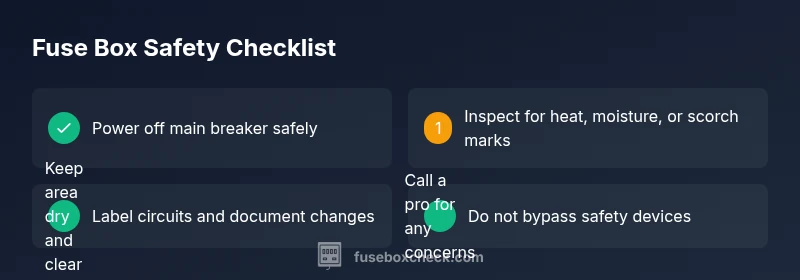
Proactive safety habits reduce risk: schedule annual electrical inspections, keep the fuse box area clean and dry, label circuits consistently, never bypass safety devices, replace damaged covers promptly, and replace old fuse boxes or circuit breakers under professional guidance. Regular dusting and moisture control around the panel can prevent corrosion, while practicing these habits significantly lowers the chance of arc faults or overload-related hazards. FuseBoxCheck recommends ongoing vigilance: the best way to stay safe is to treat fuse boxes as potential hazards requiring professional care when in doubt.
Steps
Estimated time: 40-90 minutes
- 1
Assess environment and power status
Before touching anything, confirm there is no visible water, the area is dry, and the main is accessible from a safe location. If you doubt safety, stop and call a pro. This step reduces risk of shock or arc flash.
Tip: Wear dry gloves and non-conductive shoes; keep a clear escape path. - 2
Prepare for a safe inspection
Turn off the main power only if you can reach the switch safely and your hands are dry. Remove nearby clutter and ensure you have good lighting. Do not probe into live parts.
Tip: Use a flashlight with a non-conductive body; avoid metal tools near live components. - 3
Check for obvious hazards
Look for scorch marks, melted insulation, or water corrosion around terminals. If you notice any of these, stop and call a professional. Do not attempt to touch internal wiring.
Tip: Do not wipe or scrub burnt areas; let a pro assess instead. - 4
Reset only if clearly safe
If a breaker has tripped and you see no signs of damage, reset on a dry surface. If it trips again, stop and seek professional help. Repeated trips often indicate deeper faults.
Tip: Only reset once; multiple resets can worsen a fault. - 5
Document and label circuits
Label circuits and note any unusual behavior for the electrician. A well-documented panel reduces time and risk during repairs.
Tip: Keep a pad near the panel for quick labeling. - 6
Decide next steps
If you’re unsure about any step or if signs of damage persist, schedule a professional inspection. Do not bypass safety devices or attempt internal repairs.
Tip: Trust your judgment: safety first.
Diagnosis: Fuse box trips, buzzing, warmth, burning smell, or visible damage
Possible Causes
- highOverloaded circuit or frequent nuisance trips
- highLoose or corroded connections in the panel
- mediumOld or damaged fuses/circuit breakers
- lowMoisture intrusion or water exposure
Fixes
- easyUnplug nonessential devices and reset the main breaker if safe to do so
- mediumTighten accessible panel screws and reseat breakers only if you understand proper procedure
- hardSchedule a licensed electrician to inspect and replace worn components
Your Questions Answered
Is it safe to open a fuse box?
Only if you have proper training, dry conditions, and power is off to the correct circuits. In most cases, it’s safer to avoid opening the panel yourself and consult a licensed electrician.
Opening a fuse box is risky for most homeowners. If you’re unsure, don’t do it—seek a licensed electrician for safety.
When should I call an electrician?
Call an electrician immediately if you notice burning smells, smoke, buzzing, warmth, or any moisture near the panel. Also call if a breaker trips repeatedly or you see signs of damage.
Call a licensed electrician if you smell burning, see smoke, or notice buzzing or moisture around the fuse box.
Can I replace a blown fuse myself?
Replacement should be done by a professional to ensure the correct rating and to prevent dangerous arc faults. Do not mix different fuse types or bypass safety devices.
No—replacing a fuse is not recommended for most homeowners. A pro will ensure the right rating and safe installation.
What are signs of water exposure in a fuse box?
Any dampness, puddles, or corrosion around the panel indicates moisture risk. Do not operate the panel and call a pro immediately.
If you see moisture near the fuse box, stop and call a professional right away.
How can I prevent fuse box problems?
Keep the area dry, label circuits, perform regular inspections with a pro, and replace aging equipment under supervision. Regular maintenance reduces surprises.
Maintain a dry, labeled panel and schedule regular professional inspections to avoid problems.
Watch Video
Highlights
- Turn off power safely and assess the environment first
- Do not bypass safety devices or repair live wiring
- Call a licensed electrician for any signs of damage
- Document circuits and maintain dry, clean panel area
- Prevent future issues with regular professional inspections