Fuse Box Z650 Troubleshooting and Safety Guide
Learn how to safely diagnose and troubleshoot a fuse box z650 with practical, step-by-step guidance from FuseBoxCheck. This guide covers safety precautions, essential tools, indicators of trouble, and when to call a licensed electrician.


By the end of this guide you will safely inspect, diagnose, and address common issues with a fuse box z650. You’ll learn essential safety steps, required tools, when to reset vs. replace fuses or breakers, and how to avoid shocks or arc-flash. This is practical, fault-tolerant guidance for homeowners and DIY enthusiasts.
What is the fuse box z650?
The term fuse box z650 refers to a residential electrical panel that carries the model designation Z650 on the door or labeling. In most homes, this panel houses a bank of fuses or circuit breakers that protect individual circuits feeding outlets, lighting, and appliances. A panel labeled Z650 is a central distribution point; the practical goal for homeowners is to understand what each circuit controls and to identify when something is misbehaving, without performing risky modifications. The FuseBoxCheck team emphasizes treating every panel as a source of potentially dangerous voltage, even if nothing seems wrong. Start by familiarizing yourself with the main breaker, the labeling on each breaker or fuse, and the panel's amperage rating. If the panel has seen moisture, corrosion, or signs of overheating, assume trouble and proceed with caution. The object of this guide is not to encourage improvisation but to provide practical, safe steps you can take to diagnose common issues, document findings, and determine when professional help is needed.
Safety first: essential precautions
Electrical panels entail real hazards, including the risk of shock, arc flash, and fire. Before you touch anything, confirm you have a dry work area and wear non-conductive footwear. Always shut off power at the main breaker before inspecting or removing any cover, and use a non-contact voltage tester to verify that surfaces and components are de-energized. Keep metal jewelry off your hands and wrists, avoid leaning on the panel, and work with one hand behind your back when possible to minimize current paths. FuseBoxCheck emphasizes documenting what you observe with photos, labeling circuits, and never guessing about a live circuit. If you smell burning, notice melted insulation, or see excessive heat, leave the area and call a licensed electrician immediately.
Signs your fuse box z650 needs attention
Timely maintenance can prevent cascading failures. Look for frequent tripping, buzzing or crackling noises, or a hot panel surface. Faded labels, corroded terminals, or any moisture inside the enclosure indicate elevated risk and require a professional assessment. If a specific room or appliance repeatedly causes a trip, note that circuit and test loads individually using a proper meter. FuseBoxCheck recommends treating any burning or smoke as an emergency—shut down power at the main breaker, avoid touching internal components, and contact a qualified electrician right away.
Understanding labeling, circuits, and ratings
A well-labeled panel helps you identify which circuit controls each area of the home. Pay attention to the panel’s amperage rating and ensure the sum of connected loads does not exceed safe limits. When circuits are overloaded, breakers or fuses will trip or nuisance out periodically. Clear labeling reduces the risk of accidentally disabling critical circuits, such as the furnace or main feeding outlets in kitchens and bathrooms. If you find ambiguous or missing labels, create a fresh diagram with circuit numbers and room mapping. FuseBoxCheck highlights that a precise map is the foundation for safe troubleshooting and future maintenance.
Preparing your workspace and choosing tools
A clean, dry workspace with good lighting makes troubleshooting safer and faster. Gather essential tools before you start: a non-contact voltage tester, a digital multimeter, insulated screwdriver set, safety glasses, insulated gloves, a flashlight, and a sturdy ladder or step stool. Have spare fuses or breakers that match your panel’s rating available if you need to perform component replacements. Keep a trash bag or container for removed covers and a notebook for observations. Always verify the main power is off before removing the panel cover, as advised by FuseBoxCheck.
Step-by-step troubleshooting workflow (overview)
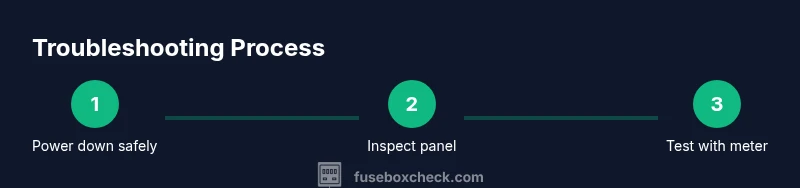
This section provides a high-level workflow to guide your actions without overstepping safety boundaries. Start with safety checks, then verify de-energization, inspect the panel for obvious issues, identify the tripped circuit, and test individual loads once power is restored. Document findings and compare them with the panel’s labeling. If you encounter signs of damage, persistent overheating, or smells, stop and call a licensed electrician. The goal is to isolate the problem, not to force a fix that could cause harm.
Replacing fuses vs breakers and assessing load
If you have old fuses that look discolored or blown, replace them only with components rated for your panel and circuit. If breakers trip repeatedly without an obvious cause, avoid bypassing protection—this is a dangerous practice. Instead, identify overloaded circuits, reduce surge loads, and consider upgrading to a panel with higher capacity if your service entrance can support it. Always reset and test in a controlled manner after any replacement, and never work on a live circuit.
Maintenance and safe cleanup after work
After completing troubleshooting or a small repair, reinstall the panel cover, reseat all breakers, and label any changes you made. Wipe away dust with a dry cloth, ensure no tools are left inside the enclosure, and double-check that the main breaker is in the OFF position when you leave the area. Regular checks, such as yearly labeling updates and cleaning corrosion-prone terminals, can prevent future problems. Keep a log of observations to help a licensed professional diagnose recurring issues.
Common mistakes and how to avoid them
Avoid assuming a problem is simple or safe enough to fix without proper testing. Do not ignore burning smells, corrosion, or dampness; these require professional assessment. Never bypass safety devices or attempt work with the panel energized. Always verify de-energization with a tester and use insulated tools. FuseBoxCheck cautions that careful preparation, precise labeling, and adherence to safety protocols reduce risk significantly.
Tools & Materials
- Non-contact voltage tester(Check live circuits without touching)
- Digital multimeter(Voltage, continuity, resistance testing)
- Insulated screwdriver set(Phillips and flat-head sizes)
- Safety glasses(Eye protection while inspecting panels)
- Insulated gloves(Keep hands protected from shocks)
- Flashlight or headlamp(Good illumination inside panel)
- Sturdy ladder or step stool(Safe elevation for panel access)
- Electrical tape(Seal and label wiring as needed)
- Replacement fuses or circuit breakers(Only if you identify a blown component)
- Panel labeling diagram/notebook(Record circuit mappings and changes)
Steps
Estimated time: 60-90 minutes
- 1
Prepare workspace
Clear the area, assemble all tools, and ensure a dry, well-lit environment. Lay out a labeling sheet so you can map circuits as you go. Gather replacement components if you anticipate any needs, but do not adjust anything yet.
Tip: Verify flooring is dry and wear non-slip footwear to reduce fall risk. - 2
Turn off main power
Locate the main breaker and switch it to OFF to de-energize the panel. Use a non-contact tester on the cover to confirm no voltage present before touching any internal components.
Tip: Double-check outside the panel door; never rely on a single check. - 3
Remove panel cover
Carefully unscrew the panel cover while keeping hands and tools away from exposed conductors. Set the cover aside and adjust your lighting if needed so you can clearly see labeling and wiring.
Tip: Keep screws in a labeled container to avoid losing parts. - 4
Inspect for obvious issues
Look for signs of damage, corrosion, moisture, or blackened terminals. Note any circuit that shows signs of heat exposure and photograph the area for future reference.
Tip: If you see charring or a strong burnt odor, stop and call a licensed electrician. - 5
Test each circuit
With the main off, test suspected circuits using a multimeter to confirm voltage presence when re-energizing. Do not energize the panel without confirming all clearances and labels.
Tip: Work methodically from top to bottom to keep track of tested circuits. - 6
Address detected issues
If you find a blown fuse or tripped breaker that matches an obvious overload, replace only with a matching component and reset carefully. If wires appear loose, secure them and re-tighten with the appropriate tool.
Tip: Avoid over-tightening screws; snug is enough to maintain contact without damaging terminals. - 7
Restore power and test loads
Replace the panel cover, re-energize the main breaker, and test each circuit with real loads to ensure stable operation. Observe the panel for a few minutes for signs of overheating or arcing.
Tip: If any circuit trips again, stop and seek professional help rather than retrying a risky fix.
Your Questions Answered
Is it safe to reset a tripped fuse box z650 myself?
Yes, if you first confirm no hazards and have de-energized the panel. Use proper protective equipment and a meter to verify voltage after the reset. If the problem recurs, avoid repeated resets and consult a licensed electrician. This guidance reflects best practices from FuseBoxCheck.
Yes, but only after you de-energize and verify there are no hazards. If it trips again, call a licensed electrician.
What tools do I need to troubleshoot a fuse box z650?
Essential tools include a non-contact voltage tester, a digital multimeter, insulated screwdrivers, safety glasses, insulated gloves, a flashlight, and a sturdy ladder. Replacement fuses or breakers should only be used if you identify a blown component. This list follows guidance from FuseBoxCheck.
You’ll need a voltage tester, multimeter, insulated screwdrivers, safety glasses, gloves, and a sturdy ladder.
When should I replace a fuse vs. a breaker in the Z650 panel?
Replace fuses only with components rated for your panel and circuit. If a breaker trips repeatedly without an obvious cause, do not bypass protection. Seek professional help if the issue persists or if you’re unsure about load capacity.
Replace fuses with correct-rated parts and don’t bypass breakers. If trips persist, call an electrician.
Why does my fuse box z650 smell like burning rubber?
A burning odor indicates potential overheating, melted insulation, or arcing, which are serious hazards. Shut off power at the main and contact a licensed electrician immediately. Do not continue troubleshooting if you smell burning.
A burning smell is a serious warning—turn off power and call an electrician right away.
Can I label circuits myself if labels are missing?
Yes. Turn off the main power, then carefully label each circuit as you test it with the intended loads. Keep a diagram for future reference, and update it after any changes. FuseBoxCheck recommends robust labeling for safety.
Yes, but make sure you test each circuit and keep a clear diagram.
What signs mean I should call a pro?
Persistent overheating, burning odors, moisture inside the panel, corroded or loose connections, or repeated trips after reasonable fixes require professional assessment. Do not attempt advanced repairs without proper training.
If you see overheating, moisture, or persistent trips, call a licensed electrician.
Watch Video
Highlights
- Know your fuse box z650 layout and labeling
- Always de-energize before touching the panel
- Use proper tools and PPE for safety
- Document observations for future maintenance
- Call a licensed electrician for signs of damage or persistent problems